Monographs: Pharmaceutical substances: Etoposide (Etoposidum)
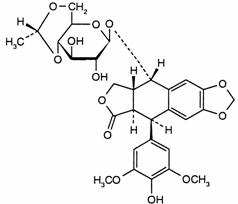
C29H32O13
Relative molecular mass. 588.6
Chemical name. 4'-Demethylepipodophyllotoxin 9-(4,6-O-ethylidene-β-Dglucopyranoside); [5R-[5α,5aβ,8aα,9β (R*)]]-9-[(4,6-O-ethylidene-b-β-glucopyranosyl)oxy]-5,8,8a,9-tetrahydro-5-(4-hydroxy-3,5-dimethyoxyphenyl) furo[3',4':6,7]naphtho[2,3-d]-1,3-dioxol-6(5aH)-one; CAS Reg. No. 33419-42-0.
Description. A white or almost white, crystalline powder.
Solubility. Practically insoluble in water; sparingly soluble in methanol R; slightly soluble in ethanol (~750 g/l) TS and dichloromethane R.
Category. Cytotoxic drug.
Storage. Etoposide should be kept in a tightly closed container.
Labelling. The designation Etoposide for parenteral use indicates that the substance complies with the additional requirements and may be used for parenteral administration. Expiry date.
Additional information. CAUTION: Etoposide must be handled with care, avoiding contact with the skin and inhalation of airborne particles.
Requirements
Etoposide contains not less than 98.0% and not more than the equivalent of 102.0% of C29H32O13, calculated with reference to the dried substance.
Identity tests
• Either test A alone or tests B, C, and D may be applied.
A. Carry out the examination as described under 1.7 Spectrophotometry in the infrared region. The infrared absorption spectrum is concordant with the spectrum obtained from etoposide RS or with the reference spectrum of etoposide.
B. See the test described below under "Related substances". The principal band obtained with solution B corresponds in position, appearance, and intensity with that obtained with solution C.
C. Transfer about 5 mg to a test-tube and dissolve in 5 mL of glacial acetic acid R, add about 0.1 mL of ferric chloride (50 g/l) TS, and mix. Cautiously add about 2 mL of sulfuric acid (~1760 g/l) TS. Without mixing allow to stand for about 30 minutes; a pink to reddish brown ring develops at the interface and the upper layer is yellow.
D. Dissolve 5 mg in 5 mL of methanol R, add 5 mL of hydrochloric acid (~70 g/l) TS, and evaporate to dryness on a water-bath. To the residue add 20 mL of water and 10 mL of dichloromethane R, and shake vigorously. Allow to separate and to 1.0 mL of the aqueous layer add 2.0 mL of anthrone TS2 and mix; a blue-green colour is produced.
Specific optical rotation. Dissolve 0.050 g in 10 mL of a mixture of 1 volume of methanol R and 9 volumes of dichloromethane R;  = -106° to -114°, calculated with reference to the dried substance.
Heavy metals. Use 1.0 g for the preparation of the test solution as described under 2.2.3 Limit test for heavy metals, Procedure 3; determine the heavy metals content according to Method A; not more than 20 μg/g.
Solution in methanol/dichloromethane. Dissolve 0.6 g in 20 mL of a mixture of 1 volume of methanol R and 9 volumes of dichloromethane R; the solution is clear and not more intensely coloured than standard colour solution 2 of the most appropriate hue, when compared as described under 1.11.1 Colour of liquids.
Sulfated ash. Not more than 1.0 mg/g.
Loss on drying. Dry at 105 °C under reduced pressure (not exceeding 0.6kPa or about 5 mm of mercury) for 4 hours; it loses not more than 30 mg/g.
Related substances. Carry out the test as described under 1.14.1 Chromatography, Thin-layer chromatography, using silica gel R1 as the coating substance and a mixture of 100 volumes of dichloromethane R, 20 volumes of acetone R, 8 volumes of glacial acetic acid R, and 1.5 volumes of water as the mobile phase. Apply separately to the plate 5μl, spread to form 10-mm bands, of each of 5 solutions in a mixture of 1 volume of methanol R and 9 volumes of dichloromethane R containing (A) 0.050 g of Etoposide per mL, (B) 5mg of Etoposide per mL, (C) 5 mg of etoposide RS per mL, (D) 0.25 mg of etoposide RS per mL, and (E) 0.10 mg of etoposide RS per mL. After removing the plate from the chromatographic chamber, dry it in a current of warm air for 5 minutes. Spray with a mixture of 1 volume of sulfuric acid (~1760 g/l) TS and 9 volumes of ethanol (~750 g/l) TS, and heat at 140 °C for 15 minutes. Cover the plate immediately with a glass plate of the same size. Examine the chromatogram in daylight.
Any band obtained with solution A, other than the principal band, is not more intense than that obtained with solution D. Furthermore, not more than two such bands are more intense than the band obtained with solution E (0.2%).
Assay. Determine as described under 1.14.1 Chromatography, High-performance liquid chromatography, using a stainless steel column (25cm × 4.6 mm) packed with particles of silica gel, the surface of which has been modified with chemically bonded octadecylsilyl groups (10μm). Prepare a diluted solution of acetic acid as follows to be used in the mobile phase and for the preparation of solution C: to 96 mL of water add 4ml of glacial acetic acid R. As the mobile phase, use a mixture of 76 volumes of the diluted acetic acid solution and 24 volumes of acetonitrile R.
Prepare the following solutions in methanol R: solution (A) 1.0 mg of Etoposide per mL; solution (B) 1.0 mg of etoposide RS per mL; and for solution (C) add 0.1 mL of the diluted acetic acid solution described above and 0.1 mL of phenolphthalein/ ethanol TS to 10ml of solution A, then add sodium hydroxide (1 mol/l) VS until the solution becomes faintly pink (about 0.15 mL), allow to stand for 15 minutes, and add 0.1 mL of the diluted acetic acid solution described above.
Operate with a flow rate of 2.0 mL per minute. As a detector use an ultraviolet spectrophotometer set at a wavelength of about 285nm.
Inject 10μl of solution C. Allow the chromatography to continue until the peak corresponding to phenolphthalein is eluted. Phenolphthalein has a retention time relative to etoposide of about 2.7. Disregard any peak due to phenolphthalein. The assay is not valid unless the chromatogram shows two principal peaks and the resolution between these peaks is at least 1.5. If necessary, reduce the concentration of acetonitrile R in the mobile phase or reduce the flow rate to achieve the required resolution.
Inject alternately 10μl each of solutions A and B.
Measure the areas of the peak responses obtained in the chromatograms from solutions A and B, and calculate the percentage content of C29H32O13.
side for parenteral use
Complies with the monograph for "Parenteral preparations".
Bacterial endotoxins. Carry out the test as described under 3.4 Test for bacterial endotoxins; contains not more than 2.0 IU of endotoxin RS per mg.
 |  |