Monographs: Pharmaceutical substances: Ferrous fumarate (Ferrosi fumaras)
Molecular formula. C4H2FeO4
Relative molecular mass. 169.9
Graphic formula.
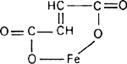
Chemical name. Iron(2+) fumarate (1:1); iron(2+) (E)-2-butenedioate (1:1); CAS Reg. No. 141-01-5.
Description. A fine, reddish orange or reddish brown powder.
Solubility. Slightly soluble in water; very slightly soluble in ethanol (~750 g/l) TS.
Category. Iron supplement.
Storage. Ferrous fumarate should be kept in a well-closed container.
Requirements
Definition. Ferrous fumarate contains not less than 93.0% and not more than 101.0% of C4H2FeO4, calculated with reference to the dried substance.
Identity tests
A. Dissolve with heating 0.4 g in 10 mL of hydrochloric acid (1 mol/l) VS and cool. (Keep 1.0 mL of this solution for test B.) To the remaining solution add 15 mL of sodium hydroxide (1 mol/l) VS. Separate the dark precipitate by filtration. To the filtrate add 0.2 mL of phenolphthalein/ethanol TS and sufficient hydrochloric acid (1 mol/l) VS until the pink colour disappears. To 2.0 mL of the resulting solution add 2.0 mL of copper(II) acetate (45 g/l) TS; a white, crystalline precipitate is produced.
B. The solution prepared in test A yields reaction A described under 2.1 General identification tests as characteristic of ferrous salts.
C. Mix 0.5 g with 1 g of resorcinol R. Transfer 0.5 g of the mixture to a crucible, add about 0.15 mL of sulfuric acid (~1760 g/l) TS and heat gently; a deep red, semi-solid mass is produced. Add the mass to a large volume of water; an orange-yellow solution is obtained which exhibits no fluorescence.
Heavy metals. Ignite 1.0 g gently until free from carbon, dissolve in 5 mL of hydrochloric acid (~420 g/l) TS by heating on a water-bath, and evaporate to dryness. Dissolve the residue in a mixture of 15 mL of hydrochloric acid (~420 g/l) TS, 4 mL of nitric acid (~1000 g/l) TS, and 6 mL of water, boil gently for 1 minute, cool, and extract the iron with 3 portions of ether R, each of 20 mL. Make a fourth extraction with a further 20 mL of ether R if the acid layer is more than slightly yellow and reject the extracts. Heat the acid solution gently to remove the ether, add 1 g of citric acid PbR, make alkaline with ammonia (~100 g/l) PbTS, add 1 mL of potassium cyanide PbTS and dilute to 40 mL with water; proceed to determine the heavy metals content as described under 2.2.3 Limit test for heavy metals, according to Method A; not more than 100 μg/g.
Arsenic. Mix 0.2 g with 1.5 g of anhydrous sodium carbonate R, add 10 mL of bromine AsTS and mix thoroughly. Evaporate to dryness on a water-bath, gently ignite, and dissolve the cooled residue in 20 mL of brominated hydrochloric acid AsTS and 10 mL of water. Transfer to a small flask, add sufficient stannous chloride AsTS to remove the yellow colour, connect to a condenser and distil 22 mL; proceed with the distillate as described under 2.2.5 Limit test for arsenic; the arsenic content is not more than 5 μg/g.
Ferric iron. Dissolve about 3 g, accurately weighed, in a mixture of 100 mL of water and 10 mL of hydrochloric acid (~420 g/l) TS by heating to boiling until dissolved. Cool rapidly and add 3 g of potassium iodide R, stopper the flask, swirl to mix, and allow to stand in the dark for 15 minutes. Titrate the liberated iodine with sodium thiosulfate (0.1 mol/l) VS, using starch TS as indicator, added towards the end of the titration. Repeat the operation without the substance being examined and determine the difference in the volume of sodium thiosulfate (0.1 mol/l) VS required for the titration. Each mL of sodium thiosulfate (0.1 mol/l) VS is equivalent to 5.585 mg of ferric iron; the ferric iron content is not more than 20 mg/g.
Sulfates. Boil 0.15 g with 8 mL of hydrochloric acid (~70 g/l) TS and 20 mL of water, cool in ice and filter; proceed with the filtrate as described under 2.2.2 Limit test for sulfates; the sulfate content is not more than 2 mg/g.
Loss on drying. Dry to constant weight at 105°C; it loses not more than 10 mg/g.
Assay. Dissolve about 0.3 g, accurately weighed, in 7.5 mL of sulfuric acid (~100 g/l) TS, heating gently. Cool, add 25 mL of water, and immediately titrate with ceric ammonium sulfate (0.1 mol/l) VS, using 0.1 mL of o-phenanthroline TS as indicator. Each mL of ceric ammonium sulfate (0.1 mol/l) VS is equivalent to 16.99 mg of C4H2FeO4.
 |  |