Monographs: Pharmaceutical substances: Pyridostigmine bromide (Pyridostigmini bromidum)
Molecular formula. C9H13BrN2O2
Relative molecular mass. 261.1
Graphic formula.
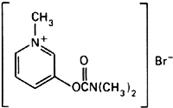
Chemical name. 3-Hydroxy-1-methylpyridinium bromide dimethylcarbamate; 3-[[(dimethylamino)carbonyl]oxy]-1-methylpyridinium bromide; CAS Reg. No. 101-26-8.
Description. A white or almost white, crystalline powder; odour, agreeable, characteristic.
Solubility. Soluble in less than 1 part of water and ethanol (~750 g/l) TS; practically insoluble in ether R.
Category. Cholinergic.
Storage. Pyridostigmine bromide should be kept in a well-closed container, protected from light.
Additional information. Pyridostigmine bromide is deliquescent.
Requirements
Definition. Pyridostigmine bromide contains not less than 98.5% and not more than 101.0% of C9H13BrN2O2, calculated with reference to the dried substance.
Identity tests
A. The absorption spectrum of a 25 μg/mL solution, when observed between 230 nm and 350 nm, exhibits a maximum at about 270 nm; the absorbance of a 1-cm layer at this wavelength is about 0.46 (preferably use 2-cm cells for the measurement and calculate the absorbance of a 1-cm layer).
B. See the test described below under "Related substances". The principal spot obtained with solution B corresponds in position, appearance, and intensity with that obtained with solution C.
C. To 0.1 g add 0.6 mL of sodium hydroxide (~80 g/l) TS; an orange colour is produced. Warm the solution; the colour changes to yellow and the vapours evolved turn moistened red litmus paper blue.
D. A 20 mg/mL solution yields reaction A described under 2.1 General identification tests as characteristic of bromides.
Melting range. 153-156°C.
Sulfated ash. Not more than 1.0 mg/g.
Loss on drying. Dry to constant weight at 105°C under reduced pressure (not exceeding 0.6 kPa or about 5 mm of mercury); it loses not more than 20 mg/g.
Related substances. Carry out the test as described under 1.14.1 Chromatography, Thin-layer chromatography using silica gel R1 as the coating substance and a mixture of 67 volumes of water, 30 volumes of methanol R, and 3 volumes of diethylamine R as the mobile phase. Apply separately to the plate 10 μl of each of 3 solutions containing (A) 20 mg of the test substance per mL, (B) 0.10 mg of the test substance per mL, and (C) 0.10 mg of pyridostigmine bromide RS per mL. After removing the plate from the chromatographic chamber, allow it to dry in a current of warm air, spray it with 4-nitroaniline TS2 and then with sodium hydroxide (0.1 mol/l) VS. Dry the plate again in a current of warm air, spray it with potassium iodobismuthate TS2 and examine the chromatogram in daylight. Any spot obtained with solution A, other than the principal spot, is not more intense than that obtained with solution B.
Assay.
In order to avoid overheating in the reaction medium, mix thoroughly throughout the titration and stop the titration immediately after the end-point has been reached.
Dissolve 0.230 g in 10 mL of anhydrous acetic acid R and add 40 mL of acetic anhydride R. Carry out a potentiometric titration using perchloric acid (0.1 mol/L) VS, as described under 2.6 Non-aqueous titration.
1 mL of perchloric acid (0.1 mol/L) is equivalent to 26.11 mg of C9H13BrN2O2.
Additional requirements for Pyridostigmine bromide for parenteral use
Complies with the monograph for "Parenteral preparations".
Bacterial endotoxins. Carry out the test as described under 3.4 Test for bacterial endotoxins; contains not more than 17.0 IU of endotoxin RS per mg.
 |  |