Monographs: Dosage forms: Specific monographs: Dexamethasone phosphate injection (Dexamethasoni phosphatis injectio)
Description. A clear, colourless solution.
Category. Adrenal hormone.
Storage. Dexamethasone phosphate injection should be kept in a tightly closed container, protected from light. It should not be allowed to freeze.
Labelling. The designation on the container should state the quantity of dexamethasone sodium phosphate in terms of equivalent amount of dexamethasone phosphate in a suitable dose volume.
Additional information. Strength in the current WHO Model List of Essential Medicines (EML): 4 mg dexamethasone phosphate/mL (as disodium phosphate salt) in 1 mL ampoule. Strength in the current WHO EML for children: 4 mg dexamethasone phosphate/mL (as disodium phosphate salt) in 1 mL ampoule.
Requirements
Complies with the monograph for Parenteral Preparations.
Definition. Dexamethasone phosphate injection is a sterile solution of Dexamethasone sodium phosphate in water for injections. It contains not less than 90.0% and not more than 110.0% of the amount of Dexamethasone phosphate C22H30FO8P stated on the label.
Identity tests
-
Carry out the test as described under 1.14.1 Chromatography, Thin-layer chromatography using silica gel R2 as the coating substance and a mixture of 60 volumes of 1-butanol R, 20 volumes of acetic acid (~300 g/L) TS and 20 volumes of water R as the mobile phase. Apply separately to the plate 5 µL of the following 3 solutions in methanol R. For solution (A), dilute a volume of the injection to obtain a solution containing 1.0 mg of dexamethasone phosphate per mL. For solution (B), use dexamethasone sodium phosphate RS to obtain a solution containing 1.0 mg of dexamethasone phosphate per mL. For solution (C), use dexamethasone sodium phosphate RS and prednisolone sodium phosphate RS to obtain a solution containing 1.0 mg of dexamethasone sodium phosphate and 1.0 mg of prednisolone sodium phosphate per mL. After removing the plate from the chromatographic chamber, allow it to dry in air and heat at 110 °C for 10 minutes. Spray the hot plate with sulfuric acid/ethanol (20%) TS and heat the plate at 120 °C for 10 minutes or until the spots appear, allow it to cool and examine the chromatogram in daylight and in ultraviolet light (365 nm).
The test is not valid unless the chromatogram obtained with solution (C) shows 2 spots which may, however, not be completely separated.
The principal spot obtained with solution (A) corresponds in position, appearance and intensity with that obtained with solution (B).
-
See the test described under "Assay". The retention time of the principal peak in the chromatogram obtained with solution (1) is similar to that in the chromatogram obtained with solution (2).
pH value (1.13). pH of the injection, 7.0–8.5.
Related substances. Carry out the test as described under 1.14.1 Chromatography, High-performance liquid chromatography using the chromatographic conditions given under "Assay".
Prepare the following solutions in mobile phase A. For solution (1), dilute a volume of the injection to obtain a concentration equivalent to 1 mg of dexamethasone phosphate per mL. For solution (2), use a solution containing 20 µg of betamethasone sodium phosphate RS per mL and 20 µg of dexamethasone sodium phosphate RS per mL. For solution (3), mix equal volumes of solution (2) and a solution containing 20 µg of dexamethasone RS per mL. For solution (4), dilute a suitable volume of solution (1) to obtain a concentration equivalent to 10 µg of dexamethasone phosphate per mL. For solution (5), transfer about 10 mg of dexamethasone sodium phosphate RS to a 10 mL volumetric flask, add 3 mL of sodium sulfite solution (dissolve about 15 g sodium sulfite R in 100 mL carbon-dioxide-free water R and adjust to pH 8.0 with sodium hydroxide (~40 g/L) TS), sonicate to dissolve and dilute to volume with carbon-dioxide-free water R, adjusted to pH 8.0 with sodium hydroxide (~40 g/L) TS. Heat the solution on a boiling water bath for 30 minutes.
Inject 20 µL of solutions (2) and (5). The test is not valid unless the resolution between the peaks due to dexamethasone phosphate (retention time about 22 min) and betamethasone phosphate (with a relative retention of about 0.95) in the chromatogram of solution (2) is at least 2.0. Use the chromatogram obtained with solution (5) to identify impurity I.
Inject alternately 20 µL each of solutions (1), (3) and (4). In the chromatogram obtained with solution (3), the following peaks are eluted at the following relative retention with reference to dexamethasone phosphate (retention time about 22 min): betamethasone phosphate: about 0.95; impurity A (dexamethasone): about 1.37.
-
In the chromatogram obtained with solution (1) the area of any peak corresponding to impurity A, when multiplied by a correction factor of 0.75, is not greater than 0.5 times the area of the principal peak obtained with solution (4) (0.5%);
-
The area of any peak corresponding to impurity I, when multiplied by a correction factor of 1.5, is not greater than the area of the principal peak obtained with solution (4) (1.0 %).
Assay. Carry out the test as described under 1.14.1 Chromatography, High-performance liquid chromatography using a stainless steel column (12.5 cm × 4.6 mm) packed with end-capped, base-deactivated particles of silica gel, the surface of which has been modified with chemically-bonded octylsilyl groups (5 µm).
Prepare solution (A) by dissolving 7.0 g of ammonium acetate R in 1000 mL of water R.
The mobile phase for the gradient elution consists of a mixture of mobile phase A and mobile phase B using the following conditions:
- Mobile phase A: mix 30 volumes of solution (A) with 35 volumes of water R, adjust to pH 3.8 with glacial acetic acid R, then add 35 volumes of methanol R;
- Mobile phase B: mix 30 volumes of solution (A), adjusted to pH 4.0 with glacial acetic acid R, and 70 volumes of methanol R.
|
Time (min) |
Mobile phase A (%v/v) |
Mobile phase B (%v/v) |
Comments |
|
0–3.5 |
90 |
10 |
Isocratic |
|
3.5–23.5 |
90 to 60 |
10 to 40 |
Linear gradient |
|
23.5–34.5 |
60 to 5 |
40 to 95 |
Linear gradient |
|
34.5–50 |
5 |
95 |
Isocratic |
|
50–55 |
5 to 90 |
95 to 10 |
Return to initial composition |
|
55–65 |
90 |
10 |
Re-equilibration |
Operate with a flow of 1.0 mL/min. As a detector, use an ultraviolet spectrophotometer set at a wavelength of 254 nm. Maintain the column temperature at 30 °C.
Prepare the following solutions in mobile phase A. For solution (1), dilute a volume of the injection to obtain a concentration of 80 µg dexamethasone phosphate per mL. For solution (2), use a solution containing 80 µg of dexamethasone phosphate RS per mL. For solution (3), use a solution containing 20 µg of betamethasone sodium phosphate RS per mL and 20 µg of dexamethasone phosphate RS per mL.
Inject 20 µL of solution (3). The test is not valid unless the resolution between the peaks due to dexamethasone phosphate (retention time about 22 min) and betamethasone phosphate (with a relative retention time of about 0.95) is at least 2.0.
Inject alternately 20 µL each of solutions (1) and (2).
Measure the areas of the peaks corresponding to dexamethasone phosphate and calculate the content of dexamethasone phosphate (C22H30FO8P) in the injection using the declared content of dexamethasone phosphate C22H30FO8P in dexamethasone phosphate RS.
Bacterial endotoxins. Carry out the test as described under 3.4 Test for bacterial endotoxins; contains less than 34.2 IU of endotoxin per mg dexamethasone phosphate.
Impurities. The impurities limited by the requirements of this monograph include impurity A listed in the monograph for Dexamethasone sodium phosphate and the following:
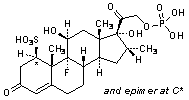
I. 9-fluoro-11β,17-dihydroxy-16α-methyl-3,20-dioxo-21-(phosphonooxy)pregn-4-ene-1-sulfonic acid.
 |  |