Monographs: Pharmaceutical substances: Pyrantel embonate (Pyranteli embonas)
Molecular formula. C11H14N2S.C23H16O6
Relative molecular mass. 594.7
Graphic formula.
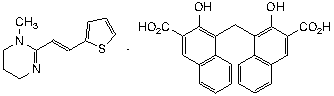
Chemical name.
1-methyl-2-[(1E)-2-(thiophen-2-yl)ethenyl]-1,4,5,6-tetrahydropyrimidine hydrogen 4,4'-methylenebis(3-hydroxynaphthalene-2-carboxylate); CAS Reg. No. 22204-24-6.
Other name. Pyrantel pamoate.
Description. A pale yellow or yellow powder.
Solubility. Practically insoluble in water and methanol R; soluble in dimethyl sulfoxide R; slightly soluble in dimethylformamide R.
Category. Anthelmintic.
Storage. Pyrantel embonate should be kept in a well-closed container, protected from light.
Requirements
Definition. Pyrantel embonate contains not less than 98.0% and not more than 102.0% of C11H14N2S,C23H16O6, calculated with reference to the dried substance.
Identity tests
- Either test A alone or tests B and C may be applied.
A. Carry out the examination as described under 1.7 Spectrophotometry in the infrared region. The infrared absorption spectrum is concordant with the spectrum obtained from pyrantel embonate RS or with the reference spectrum of pyrantel embonate.
B. The absorption spectrum of a 13 μg/mL solution in methanol R, when observed between 230 nm and 360 nm, exhibits 2 maxima at about 288 nm and 300 nm. The ratio of the absorbance at 288 nm to that at 300 nm is about 1.0.
C. Carry out the test as described under 1.14.1 Chromatography, High-performance liquid chromatography using the conditions given under “Related substances”. The retention times of the two principal peaks in the chromatogram obtained with solution (1) correspond to the retention times of peaks obtained from pyrantel embonate RS similarly prepared.
Chlorides. Dissolve 1.15 g of Pyrantel embonate in a mixture of 5 mL of nitric acid (~130 g/L) TS and 15 mL of water R. Heat on a water-bath for 5 minutes, allow to cool, dilute to 25 mL with water R, mix well and filter. Add 1 mL of nitric acid (~130 g/L) TS to 15 mL of the filtrate and proceed as described under 2.2.1 Limit test for chlorides; the chloride content is not more than 0.36 mg/g.
Sulfates. Dissolve 0.48 g of Pyrantel embonate in 2.5 mL of nitric acid (~130 g/L) TS and dilute to 30 mL with water R. Heat on a water-bath for 5 minutes, shake for 2 minutes, cool and filter and proceed as described under 2.2.2 Limit test for sulfates; the sulfate content is not more than 1 mg/g.
Iron. Ignite 0.53 g of Pyrantel embonate at 800 ± 50 °C for 2 hours. Cool and dissolve the residue in 2.5 mL of hydrochloric acid (~70 g/L) with gentle heating for 10 minutes. Cool and dilute to 40 mL with water R and proceed as described under 2.2.4 Limit test for iron; not more than 75 μg/g.
Sulfated ash. Not more than 1.0 mg/g.
Heavy metals. Use 1.0 g for the preparation of the test solution as described under 2.2.3 Limit test for heavy metals, procedure 3; determine the heavy metals content according to method A; not more than 20 μg/g.
Loss on drying. Dry at 60 °C under reduced pressure (not exceeding 0.6 kPa or about 5 mm of mercury) for 3 hours; it loses not more than 10 mg/g.
Related substances
Carry out the operations in subdued light and without any prolonged interruptions, preferably using low-actinic glassware.
Carry out the test as described under 1.14.1 Chromatography, High-performance liquid chromatography using a stainless steel column (25 cm × 4.6 mm) packed with particles of silica gel for chromatography R (5 μm).
As the mobile phase use a mixture of 92.8 volumes of acetonitrile R and 7.2 volumes of a solvent mixture composed of 5 volumes of glacial acetic R, 5 volumes of water R and 2 volumes of diethylamine R.
Prepare the following solutions. For solution (1) transfer about 70 mg of Pyrantel embonate, accurately weighed, to a 100 mL volumetric flask. Add 7 mL of a mixture composed of 5 volumes of glacial acetic R, 5 volumes of water R and 2 volumes of diethylamine R. Shake and dilute to volume with acetonitrile R, mix and filter. For solution (2) dilute 1.0 mL of the solution (1) to 100.0 mL with mobile phase. For solution (3) expose 10 mL of solution (1) under 2000 lux illumination for 24 hours. In case a suitable device to provide the requested illuminance is not available transfer 10 mg of pyrantel embonate impurity A RS to a 10.0 mL flask, add 8 mL of solution (1) and make up to volume with dimethylformamide R to obtain solution (3).
Operate with a flow rate of 1.0 mL per minute. As a detector use an ultraviolet spectrophotometer set at a wavelength of about 288 nm.
Inject separately 20 μL each of solution (1), (2) and (3) and record the chromatograms for 4 times the retention time of pyrantel.
In the chromatogram obtained with solution (3) the following peaks are eluted at the following relative retention with reference to pyrantel (retention time about 14 minutes): embonic acid about 0.5; impurity A about 1.3. The test is not valid unless the resolution factor between the pyrantel peak and the impurity A peak is at least 4.0.
In the chromatogram obtained with solution (1):
- the area of any peak corresponding to impurity A is not greater than 0.5 times the area of the pyrantel peak obtained with solution (2) (0.5%);
- the area of any other peak, other than the two principal peaks, is not greater than 0.2 times the area of the pyrantel peak obtained with solution (2) (0.2%);
- the sum of any peak corresponding to impurity A and the areas of all other peaks, other than the two principal peaks, is not greater that the area of the pyrantel peak obtained with solution (2) (1.0%). Disregard any peak with an area less than 0.05 times the area of the principal peak obtained with solution (2) (0.05%).
Assay
Perform the assay in subdued light and without any prolonged interruptions, preferably using low-actinic glassware.
Dissolve about 0.450 g of Pyrantel embonate, accurately weighed, in 10 mL of acetic anhydride R and 50 mL of glacial acetic acid R. Heat at 50 °C and stir for 10 minutes. Allow to cool and titrate the suspension with perchloric acid (0.1 mol/L) VS as described under 2.6 Nonaqueous titration, method A, determining the end-point potentiometrically. Carry out a blank titration.
Each mL of perchloric acid (0.1 mol/L) VS is equivalent to 59.47 mg of pyrantel embonate C11H14N2S,C23H16O6.
Impurities

A. 1-methyl-2-[(1Z)-2-(thiophen-2-yl)ethenyl]-1,4,5,6-tetrahydropyrimidine.
 |  |