Monographs: Pharmaceutical substances: Ethosuximide (Ethosuximidum)
Molecular formula. C7H11NO2
Relative molecular mass. 141.2
Graphic formula.
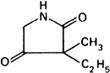
Chemical name. 2-Ethyl-2-methylsuccinimide; 3-ethyl-3-methyl-2,5-pyrrolidinedione; CAS Reg. No. 77-67-8.
Description. A white or almost white powder or waxy solid; odourless or with a faint characteristic odour.
Solubility. Freely soluble in water; very soluble in ethanol (~750 g/l) TS and ether R.
Category. Anticonvulsant.
Storage. Ethosuximide should be kept in a tightly closed container, protected from light.
Additional information. Even in the absence of light, Ethosuximide is gradually degraded on exposure to a humid atmosphere, the decomposition being faster at higher temperatures.
Requirements
Definition. Ethosuximide contains not less than 99.0% and not more than 100.5% of C7H11NO2, calculated with reference to the anhydrous substance.
Identity tests
• Either test A alone or tests B and C may be applied.
A. Carry out the examination as described under 1.7 Spectrophotometry in the infrared region. The infrared absorption spectrum is concordant with the spectrum obtained from ethosuximide RS or with the reference spectrum of ethosuximide. If the spectrum obtained from the solid state of the test substance is not concordant with the spectrum obtained from the reference substance, dissolve a small amount of the substance in ethanol (~750 g/l) TS, evaporate to dryness on a water-bath, and prepare a potassium bromide disc as described in Method 3. Then compare the spectrum obtained from the disc with that of the reference substance.
B. Heat 0.1 g with 0.2 g of resorcinol R and 2 drops of sulfuric acid (~1760 g/l) TS at 140°C for 5 minutes, allow to cool, add 5 mL of water, make alkaline with sodium hydroxide (~80 g/l) TS, and pour a few drops into a large volume of water; a bright green fluorescence is obtained.
C. Melting temperature, about 46°C.
Cyanides. Dissolve 1 g in 10 mL of ethanol (~750 g/l) TS, add 3 drops of ferrous sulfate (15 g/l) TS, 1 mL of sodium hydroxide (~80 g/l) TS and a few drops of ferric chloride (25 g/l) TS. Warm gently, and acidify with sulfuric acid (~100 g/l) TS; no blue precipitate or blue colour is produced within 15 minutes.
Sulfated ash. Not more than 5.0 mg/g.
Water. Determine as described under 2.8 Determination of water by the Karl Fischer method, Method A, using about 1 g of the substance; the water content is not more than 5.0 mg/g.
Acidity. Dissolve 5.0 g in 50 mL of water by warming on a water-bath for 5 minutes. Cool and titrate with sodium hydroxide (0.1 mol/l) VS, using bromocresol green/ethanol TS as indicator; not more than 0.7 mL is required to obtain the midpoint of the indicator (green).
Related substances. Carry out the test as described under 1.14.1 Chromatography, Thin-layer chromatography, using silica gel R2 as the coating substance and a mixture of 9 volumes of chloroform R and 1 volume of acetone R as the mobile phase. Apply separately to the plate 10 μl of each of 2 solutions in ethanol (~750 g/l) TS containing (A) 50 mg of the test substance per mL and (B) 0.050 mg of the test substance per mL. After removing the plate from the chromatographic chamber allow it to dry in air, and examine the chromatogram in ultraviolet light (254 nm). Any spot obtained with solution A, other than the principal spot, is not more intense than that obtained with solution B.
Assay. Dissolve about 0.28 g, accurately weighed, in 30 mL of dimethylformamide R, add 3 drops of azo violet TS and titrate with tetrabutylammonium hydroxide (0.1 mol/l) VS to a blue end-point, as described under 2.6 Non-aqueous titration. Method B. Each mL of tetrabutylammonium hydroxide (0.1 mol/l) VS is equivalent to 14.12 mg of C7H11NO2.
 |  |