Monographs: Pharmaceutical substances: Estradiol valerate (Estradioli valeras)
Molecular formula. C23H32O3
Relative molecular mass. 356.5
Graphic formula.
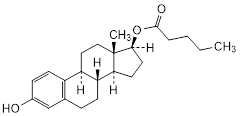
Chemical name. 3-Hydroxyestra-1,3,5(10)-trien-17β-yl pentanoate (IUPAC), Estra-1,3,5(10)-triene-3,17-diol (17β)-, 17-pentanoate. Estradiol, 17-valerate (CAS); CAS Reg. No. 979-32-8.
Description. A white, or almost white, crystalline powder or colourless crystals.
Solubility. Practically insoluble in water R; soluble in methanol R; freely soluble in ethanol R, acetone R and methylene chloride R.
Category. Estrogen.
Storage. Estradiol valerate should be kept in a tight container, protected from light.
Requirements
Definition. Estradiol valerate contains not less than 97.5% and not more than 102.0% of C23H32O3, calculated with reference to the dried substance.
Identity tests
- Either tests A and C or tests B and C may be applied.
A. Carry out the test as described under 1.7 Spectrophotometry in the infrared region. The infrared absorption spectrum is concordant with the spectrum obtained from estradiol valerate RS or with the reference spectrum of estradiol valerate.
B. Carry out the test as described under 1.14.1 Chromatography, High-performance liquid chromatography, using the conditions described under “Assay”. The retention time of the principal peak in the chromatogram obtained with solution (1) corresponds to the retention time of the peak due to estradiol valerate in the chromatogram obtained with solution (2).
C. Determine the specific optical rotation (1.4) using a 25 mg per mL solution of the test substance in methanol R. Calculate with reference to the dried substance:
= +41 to +47.
Clarity and colour of solution. A solution of 0.500 g of the test substance in 20 mL of methanol R is clear and colourless when analysed, as described under 1.11.2 Degree of coloration of liquids, method II.
Loss on drying. Dry 0.500 g of the test substance to a constant weight at 105 ℃; it does not lose more than 10.0 mg/g.
Related substances. Carry out the test as described under 1.14.1 Chromatography, High-performance liquid chromatography , using a stainless steel column (10 cm × 4.6 mm) packed with end-capped particles of silica gel, the surface of which has been modified with chemically-bonded octadecylsilyl groups (2.6 μm).
Use the following conditions for gradient elution:
- mobile phase A: water R; and
- mobile phase B: acetonitrile for chromatography R.
|
Time (min) |
Mobile phase A (% v/v) |
Mobile phase B (% v/v) |
Comments |
|
0–1 |
48 |
52 |
Isocratic |
|
1–10 |
48 to 35 |
52 to 65 |
Linear gradient |
|
10–17.5 |
35 to 0 |
65 to 100 |
Linear gradient |
|
17.5–26 |
0 |
100 |
Isocratic |
|
26–27 |
0 to 48 |
100 to 52 |
Return to initial composition |
|
27–32 |
48 |
52 |
Re-equilibration |
Operate with a flow rate of 2.0 mL per minute. As a detector, use an ultraviolet spectrophotometer set at a wavelength of 220 nm.
Prepare the following solutions in acetonitrile for chromatography R. For solution (1), dissolve 50 mg of the test substance and dilute to 10.0 mL. For solution (2), dilute 1.0 mL of solution (1) to 100.0 mL. Dilute 1.0 mL of this solution to 10.0 mL. For solution (3), dissolve 3 mg of estradiol valerate for system suitability RS (containing estradiol valerate and the impurities A, C, D and E) and dilute to 1.0 mL.
Inject alternately 5 μL each of solutions (1), (2) and (3) and record the chromatograms.
Use the chromatogram obtained with solution (3), and the chromatogram supplied with estradiol valerate for system suitability RS, to identify the peaks due to estradiol valerate and the impurities A, C, D and E in the chromatogram obtained with solution (1). The impurities, if present, are eluted at the following relative retentions with reference to estradiol valerate (retention time about 9 minutes): impurity A about 0.1; impurity C about 0.9; impurity D about 1.3; and impurity E about 1.7.
The test is not valid unless the resolution between the peaks due to estradiol valerate and the peak due to impurity C is at least 2.5 in the chromatogram obtained with solution (3).
In the chromatograms obtained with test solution (1):
- the area of any peak corresponding to either impurity A or D is not greater than 5 times the area of the peak due to estradiol valerate obtained with solution (2) (0.5%);
- the area of any peak corresponding to impurity C, when multiplied by a correction factor of 0.5, is not greater than 5 times the area of the peak due to estradiol valerate obtained with solution (2) (0.5%);
- the area of any peak corresponding to impurity E is not greater than 1.5 times the area of the peak due to estradiol valerate obtained with solution (2) (0.15%);
- the area of any other impurity peak is not greater than the area of the peak due to estradiol valerate obtained with solution (2) (0.10%); and
- the sum of the corrected area of any peak corresponding to impurity C and the areas of all other impurity peaks, is not greater than 10 times the area of the peak due to estradiol valerate obtained with the solution (2) (1.0 %). Disregard any peak with an area less than 0.5 times the area of the peak due to estradiol valerate obtained with solution (2) (0.05%).
Assay. Carry out the test as described under 1.14.1 Chromatography, High-performance liquid chromatography using the chromatographic conditions as described under “Related substances”.
Prepare the following solutions in acetonitrile for chromatography R. For solution (1), dissolve 60.0 mg of the test substance and dilute to 50.0 mL. For solution (2), dissolve 60.0 mg of estradiol valerate RS and dilute to 50.0 mL.
Inject alternately 5 μL each of solution (1) and (2) and record the chromatograms.
Measure the areas of the peaks corresponding to estradiol valerate obtained in the chromatograms of solutions (1) and (2) and calculate the percentage content of C23H32O3, using the declared content of C23H32O3 in estradiol valerate RS.
Impurities.
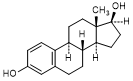
A. estra-1,3,5(10)-triene-3,17β-diol (estradiol) (synthesis-related impurity, degradation product).
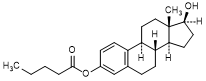
B. 17β-hydroxyestra-1,3,5(10)-trien-3-yl pentanoate (estradiol 3-valerate).
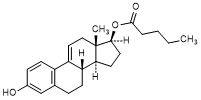
C. 3-hydroxyestra-1,3,5(10),9(11)-tetraen-17β-yl pentanoate (degradation product).
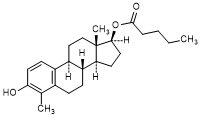
D. 3-hydroxy-4-methylestra-1,3,5(10)-trien-17β-yl pentanoate (synthesis-related impurity).
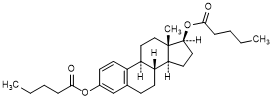
E. estra-1,3,5(10)-trien-3,17β-diyl dipentanoate (synthesis-related impurity).
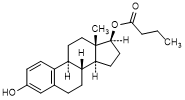
F. 3-hydroxyestra-1,3,5(10)-trien-17β-yl butanoate (synthesis-related impurity).
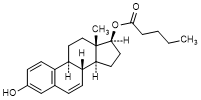
G. 3-hydroxyestra-1,3,5(10),6-tetraen-17β-yl pentanoate (degradation product).
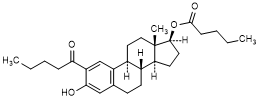
H. 3-hydroxy-2-(pentanoyl)estra-1,3,5(10)-trien-17β-yl pentanoate.
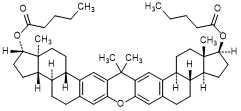
I. (1S,3aS,3bR,10aR,10bS,13S,13aS,15aS,18bS,20aS)-13a,17,17,20a-tetramethyl-2,3,3a,3b,4,5,9,10,10a,10b,11,12,13,13a,14,15,15a,17,18b,19,20,20a-docosahydro-1H-bis(cyclopenta[5,6]naphto)[1,2-b:2',1'-i]xanthene-1,13-diyl dipentanoate.
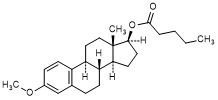
J. 3-methoxyestra-1,3,5(10)-trien-17β-yl pentanoate.
 |  |