Monographs: Pharmaceutical substances: Erythromycin stearate (Erythromycini stearas)
Molecular formula. C37H67NO13,C18H36O2
Relative molecular mass. 1018
Graphic formula.
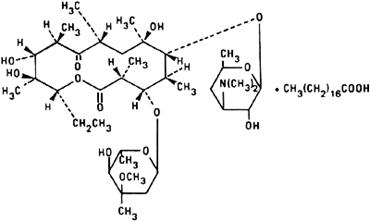
Chemical name. Erythromycin stearate (salt); erythromycin octadecanoate (salt); [3R-(3R*,4S*,5S*,6R*,7R*,9R*,11R*,12R*,13S*,14R*)]-4-[(2,6-dideoxy-3-C-methyl-3-O-methyl-α-L-ribo-hexopyranosyl)oxy]-14-ethyl-7,12,13-trihydroxy-3,5,7,9,11,13-hexamethyl-6-[[3,4,6-trideoxy-3-(dimethylamino)-β-D-xylo-hexopyranosyl]oxy]oxacyclotetradecane-2,10-dione octadecanoate (salt); CAS Reg. No. 643-22-1.
Description. Colourless or slightly yellow crystals or a white or slightly yellow powder; odourless or almost odourless.
Solubility. Practically insoluble in water; soluble in ethanol (~750 g/l) TS; soluble in methanol R, and ether R; these solutions may be opalescent.
Category. Antibacterial drug.
Storage. Erythromycin stearate should be kept in a tightly closed container, protected from light.
Requirements
Definition. Erythromycin stearate contains not less than 550 International Units of erythromycin per mg or not less than 77.0% of C37H67NO13,C18H36O2, both calculated with reference to the anhydrous substance.
Identity tests
• Either test A or tests B, C and D may be applied.
A. Carry out the examination as described under 1.7 Spectrophotometry in the infrared region. The infrared absorption spectrum is concordant with the spectrum obtained from erythromycin stearate RS or with the reference spectrum of erythromycin stearate.
B. Dissolve 3 mg in 2 mL of acetone R and add 2 mL of hydrochloric acid (~420 g/l) TS; an orange colour is produced, which changes to red and then to deep purplish red. Add 2 mL of chloroform R and shake; the chloroform layer becomes purple.
C. To 5 mg add 5 mL of xanthydrol TS and heat on a water-bath; a red colour is produced.
D. Heat gently 0.1 g with 5 mL of hydrochloric acid (~70 g/l) TS and 10 mL of water until the solution boils; oily globules rise to the surface. Cool, remove the fatty layer and heat it with 3 mL of sodium hydroxide (0.1 mol/l) VS; allow to cool; the solution sets to a gel. Add 10 mL of hot water and shake; the solution froths. To 1 mL add 1 mL of calcium chloride (~55 g/l) TS; a granular precipitate, insoluble in hydrochloric acid (~250 g/l) TS, is produced.
Erythromycin stearate. Shake 0.5 g with 30 mL of chloroform R. If the solution is clear, add 50 mL of glacial acetic acid R1, previously neutralized with perchloric acid (0.1 mol/l) VS, and continue with the titration as described below.
If the solution is opalescent, shake with an additional 2 quantities, each of 25 mL of chloroform R, filter each extract, wash the filter with chloroform R, and evaporate the combined filtrate and washings on a water-bath to about 30 mL. Add 50 mL of glacial acetic acid R1, previously neutralized with perchloric acid (0.1 mol/l) VS, and titrate with perchloric acid (0.1 mol/l) VS, determining the end-point potentiometrically. Each mL of perchloric acid (0.1 mol/l) VS is equivalent to 101.8 mg of C37H67NO13,C18H36O2; the erythromycin stearate content is not less than 0.770 g/g.
Water. Determine as described under 2.8 Determination of water by the Karl Fischer method, Method A, using about 0.6 g of the substance; the water content is not more than 40 mg/g.
Free stearic acid. Dissolve 0.4 g in 50 mL of neutralized ethanol TS and titrate with sodium hydroxide (0.1 mol/l) VS, determining the end-point potentiometrically. Calculate the volume of sodium hydroxide (0.1 mol/l) VS required for each g of the substance and subtract the volume of perchloric acid (0.1 mol/l) VS required for each g of the substance in the test for erythromycin stearate. Each mL of the difference is equivalent to 28.45 mg of C18H36O2; not more than 185 mg/g.
Sodium stearate. Moisten 2.0 g in a platinum dish with a small quantity of sulfuric acid (~1760 g/l) TS, ignite gently, again moisten with sulfuric acid (~1760 g/l) TS, ignite at about 800°C, cool, and weigh. Each g of residue is equivalent to 4.317 g of C18H35NaO2; not more than 60 mg/g.
Total stearic acid, stearates and water. Using the results of the above four determinations, add together the percentages of free stearic acid, erythromycin stearate, sodium stearate (all calculated with reference to the undried substance) and the water content; the total is not less than 98.0% and not more than 103.0%.
Assay. Dissolve 50 mg in sufficient methanol R to produce 100 mL and carry out the assay as described under 3.1 Microbiological assay of antibiotics, using Bacillus pumilus (NCTC 8241 or ATCC 14884) as the test organism, culture medium Cm1 with a final pH of 8.0-8.1, sterile phosphate buffer, pH 8.0 TS1 or TS2, an appropriate concentration of erythromycin (usually between 5 and 25 IU per mL), and an incubation temperature of 35-39 °C. The precision of the assay is such that the fiducial limits of error of the estimated potency (P = 0.95) are not less than 95% and not more than 105% of the estimated potency. The upper fiducial limit of error of the estimated potency (P = 0.95) is not less than 550 IU of erythromycin per mg, calculated with reference to the anhydrous substance.
 |  |