Monographs: Pharmaceutical substances: Erythromycin lactobionate (Erythromycini lactobionas)
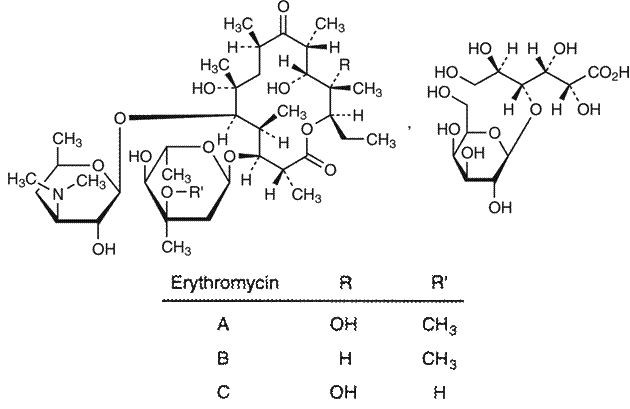
C37H67NO13,C12H22O12
Relative molecular mass. 1092
Chemical name. Erythromycin lactobionate (1:1) (salt); erythromycin mono(4-O-β-D-galactopyranosyl-D-gluconate) (salt); CAS Reg. No. 3847-29-8.
Description. White or slightly yellow crystals or a white, crystalline powder; odour, faint.
Solubility. Freely soluble in water, ethanol (~750 g/l) TS and methanol R; slightly soluble in acetone R; practically insoluble in ether R.
Category. Antibacterial drug.
Storage. Erythromycin lactobionate should be kept in a tightly closed container, protected from light.
Additional information. Each mg of erythromycin lactobionate is equivalent to 0.6722 mg of erythromycin.
Requirements
Definition. Erythromycin lactobionate contains not less than 600 IU of erythromycin per mg, calculated with reference to the anhydrous substance.
Identity tests
• Either test A alone or tests B, C, and D may be applied.
A. Carry out the examination as described under 1.7 Spectrophotometry in the infrared region. The infrared absorption spectrum is concordant with the spectrum obtained from erythromycin lactobionate RS or with the reference spectrum of erythromycin lactobionate.
B. See the test described below under "Related substances". One of the two principal spots obtained with solution A corresponds in position with the principal spot obtained with solution B. The other principal spot corresponds in position with the principal spot obtained with solution D.
C. Dissolve 20 mg in 2.0 mL of water and cautiously add about 1 mL of sulfuric acid (~1760 g/l) TS to form a lower layer; a red-brown ring appears at the interface of the two liquids. Shake; a dark red-brown solution is produced.
D. Dissolve about 10 mg in 5 mL of hydrochloric acid (~250 g/l) TS; a yellowish green colour develops.
Clarity and colour of solution. A solution of 0.85 g in 10 mL of water is clear or not more opalescent than opalescence standard TS1, and colourless or not more intensely coloured than standard colour solution Yw1 when compared as described under 1.11.1 Colour of liquids.
Water. Determine as described under 2.8 Determination of water by the Karl Fischer method, Method A, using about 0.5 g of Erythromycin lactobionate; the water content is not more than 0.050 g/g.
Sulfated ash. Not more than 20 mg/g.
pH value. pH of a 0.05 g/mL solution in carbon-dioxide-free water R, 6.0-7.5.
Related substances. Carry out the test as described under 1.14.1 Chromatography, Thin-layer chromatography, using silanized silica gel R3 as the coating substance and a mixture of 5 volumes of methanol R and 3 volumes of ammonium acetate (50 g/l) TS as the mobile phase. Apply separately to the plate 10μl of each of 4 solutions in methanol R containing (A) 3mg of Erythromycin lactobionate per mL, (B) 2mg of erythromycin RS per mL, (C) 0.10mg of erythromycin RS per mL, and (D) 0.66 mg of lactobionic acid R per mL. After removing the plate from the chromatographic chamber, allow it to dry in air until the solvents have evaporated, spray with anisaldehyde TS, heat at 110°C for 5 minutes, and allow to cool. Examine the chromatogram in daylight.
Disregard the spot corresponding to lactobionic acid. Any spot obtained with solution A, other than the principal spot and any spot with a lower Rf -value, is not more intense than that obtained with solution B. Any spot obtained with solution A, other than the principal spot and any spot with a higher Rf -value, is not more intense than that obtained with solution C.
Assay. Carry out the determination as described under 3.1 Microbiological assay of antibiotics, using either (a) Bacillus pumilus (NCTC 8241 or ATCC 14884) as the test organism, culture medium Cm1 with a final pH of 8.0-8.1, sterile phosphate buffer, pH 8.0, TS, an appropriate concentration of erythromycin (usually between 5 and 25 IU per mL), and an incubation temperature of 35-39 °C, or (b) Micrococcus luteus (ATCC 9341) as the test organism, culture medium Cm1 with a final pH of 8.0-8.1, sterile phosphate buffer, pH 8.0, TS1, or TS2, an appropriate concentration of erythromycin (usually between 0.5 and 1.5 IU per mL), and an incubation temperature of 32-35 °C. The precision of the assay is such that the fiducial limits of error of the estimated potency (P = 0.95) are not less than 95% and not more than 105% of the estimated potency.
 |  |