Methods of Analysis: 5. Pharmaceutical technical procedures: 5.5 Dissolution test for oral dosage forms
This text is based on the internationally-harmonized texts developed by the Pharmacopoeial Discussion Group (PDG). It has been developed in line with the style and requirements used in The International Pharmacopoeia. The additional sections on Oral suspensions, powders for oral suspension and granules for oral suspenion and on Monographs of The International Pharmacopoeia are not part of the PDG text.
For further guidance, see also the chapter Dissolution testing of tablets and capsules in the Supplementary Information section.
This test determines the amount of active ingredient(s) released from an oral dosage form, under controlled conditions using a known volume of dissolution medium within a predetermined length of time.
Basket apparatus. The assembly consists of the following: a vessel, which may be covered, made of glass or other inert, transparent material, which should not sorb, react or interfere with the preparation to be tested; a motor; a drive shaft; and a cylindrical basket (stirring element). The vessel is partially immersed in a suitable water bath of any convenient size or heated by a suitable device such as a heating jacket. The water bath or heating device permits maintaining the temperature inside the vessel at 37 ± 0.5 ºC during the test. No part of the assembly, including the environment in which the assembly is placed, contributes significant motion, agitation or vibration beyond that due to the smoothly rotating stirring element. An apparatus that permits observation of the preparation and stirring element during the test is preferable. The vessel is cylindrical with a hemispherical bottom and a capacity of 1 litre. Its height is 160–210 mm and its inside diameter is 98–106 mm. Its sides are flanged at the top. A fitted cover may be used to retard evaporation. If a cover is used, it provides sufficient openings to allow ready insertion of the thermometer and withdrawal of samples. The shaft is positioned so that its axis is not more than 2 mm at any point from the vertical axis of the vessel and rotates smoothly and without significant wobble that could affect the results. A speed-regulating device is used that allows the shaft rotation speed to be selected and maintained at a specified rate within ± 4%.
Shaft and basket components of the stirring element are fabricated of stainless steel, type 316 or equivalent, to the specifications shown in Figure 1. A basket having a gold coating of about 2.5 µm (0.0001 inch) thick may be used. The dosage unit is placed in a dry basket at the beginning of each test. The distance between the inside bottom of the vessel and the bottom of the basket is maintained at 25 ± 2 mm during the test.
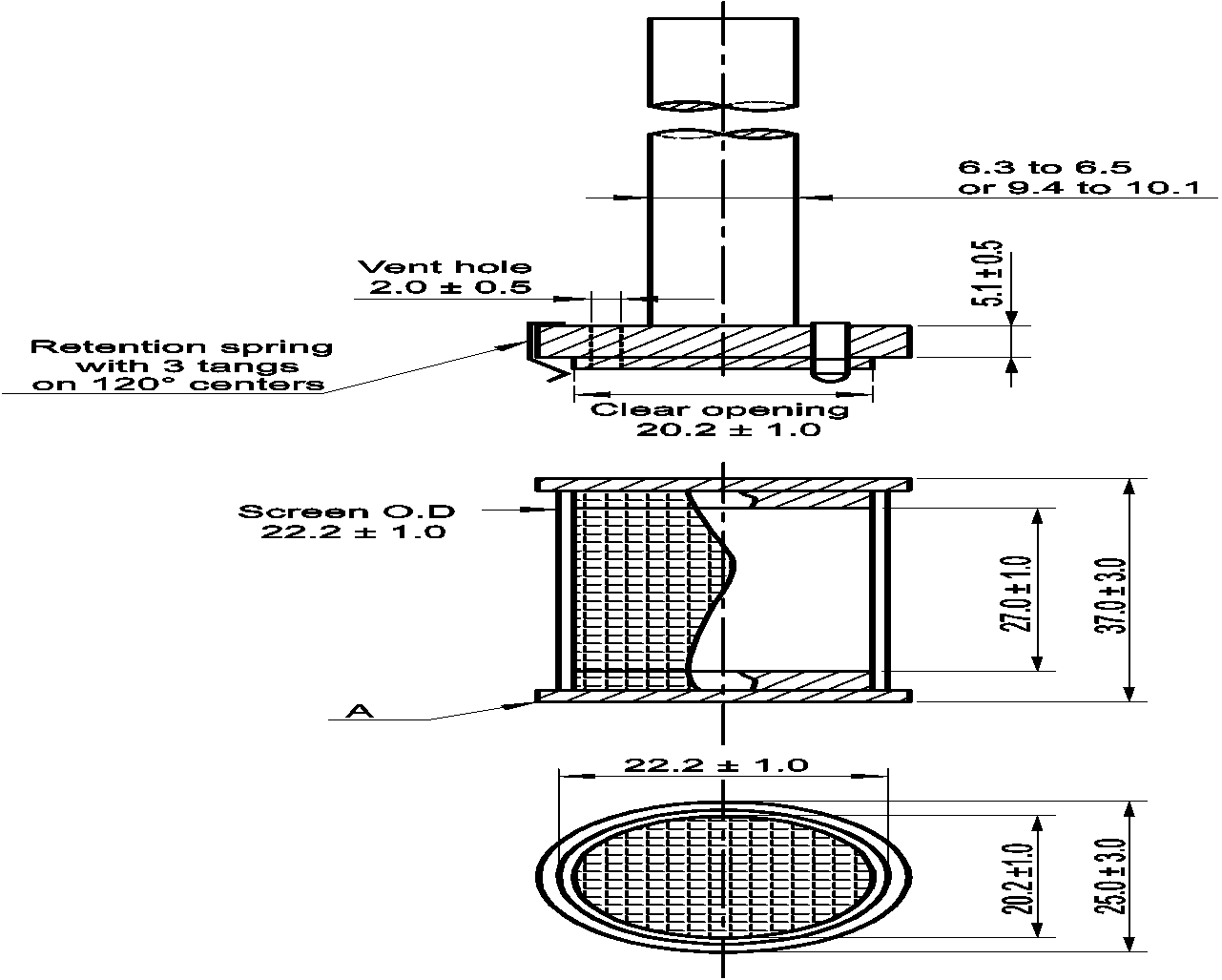
1. Screen with welded seam: 0.22–0.31 mm wire diameter with wire opening of 0.36–0.44 mm. After welding, the screen may be slightly altered.
2. Maximum allowable runout at "A" is 1.0 mm when the part is rotated on centre line axis with basket mounted.
Figure 1. Basket stirring element; dimensions in millimetres.
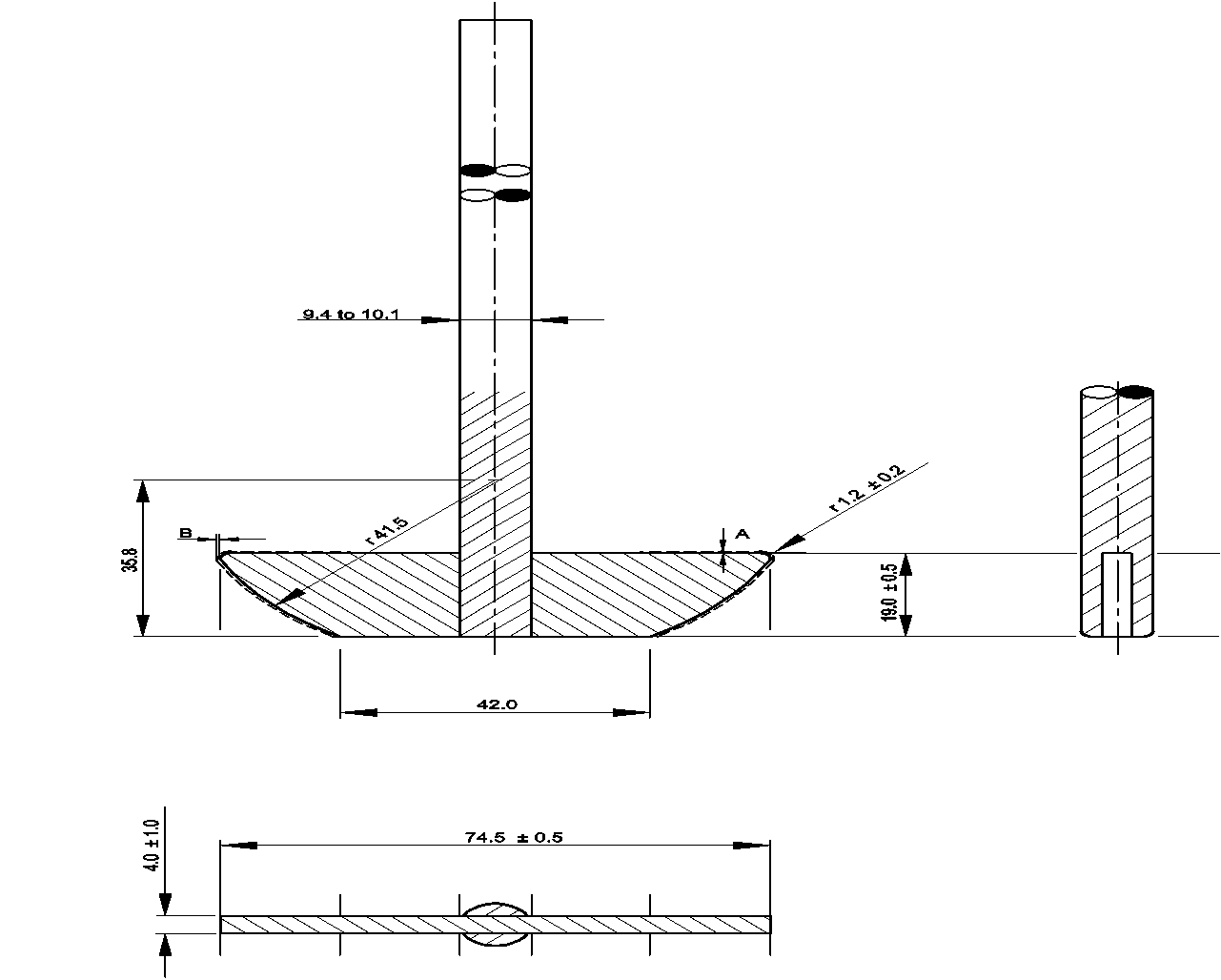
A and B dimensions do not vary more than 0.5 mm when part is rotated on centre line axis. Tolerances are ± 1.0 mm unless otherwise stated.
Figure 2. Paddle stirring element; dimensions in millimetres.
Paddle apparatus. Use the assembly from the basket apparatus except that a paddle formed from a blade and a shaft is used as the stirring element. The shaft is positioned so that its axis is not more than 2 mm from the vertical axis of the vessel at any point and rotates smoothly without significant wobble that could affect the results. The vertical centre line of the blade passes through the axis of the shaft so that the bottom of the blade is flush with the bottom of the shaft. The paddle conforms to the specifications shown in Figure 2. The distance of 25 ± 2 mm between the bottom of the blade and the inside bottom of the vessel is maintained during the test. The metallic or suitably inert, rigid blade and shaft comprise a single entity. A suitable two-part detachable design may be used provided the assembly remains firmly engaged during the test. The paddle blade and shaft may be coated with a suitable coating so as to make them inert. The dosage unit is allowed to sink to the bottom of the vessel before rotation of the blade is started. A small, loose piece of non-reactive material, such as not more than a few turns of wire helix, may be attached to dosage units that would otherwise float. An alternative sinker device is shown in Figure 3. Other validated sinker devices may be used.
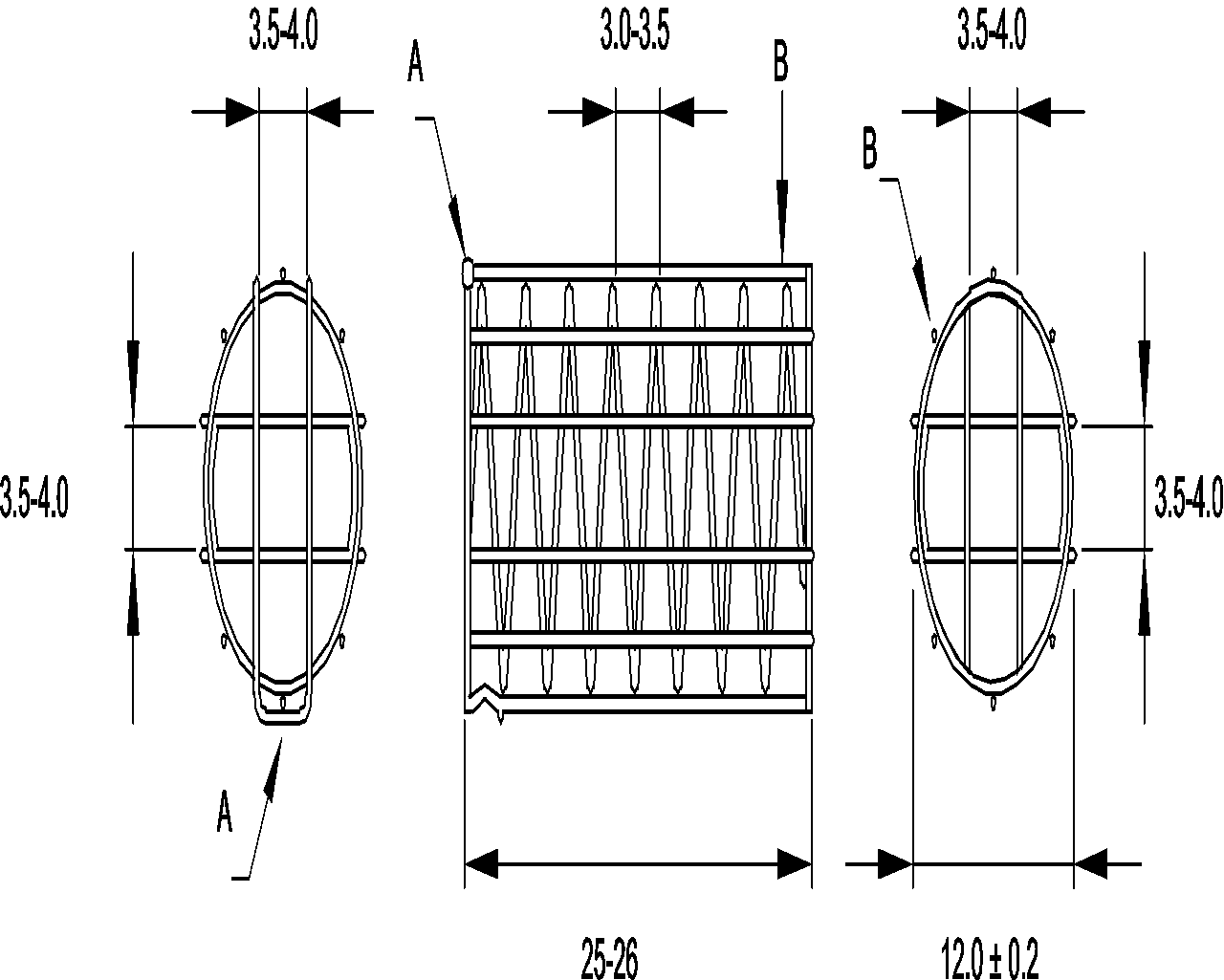
Figure 3. Alternative sinker. A: acid-resistant wire clasp; B: acid-resistant wire support; dimensions in millimeters.
Recommended procedure
Conventional-release (or immediate-release) dosage forms
Procedure. Place the stated volume of the dissolution medium (± 1%) in the vessel of the specified apparatus. Assemble the apparatus, equilibrate the dissolution medium to 37 ± 0.5 °C and remove the thermometer. The test may also be carried out with the thermometer in place, provided it is shown that results equivalent to those obtained without the thermometer are obtained. Place one dosage unit in the apparatus taking care to exclude air bubbles from the surface of the dosage unit. Operate the apparatus at the specified rate. Within the time interval specified, or at each of the times stated, withdraw a sample from a zone midway between the surface of the dissolution medium and the top of the rotating basket or blade not less than 1 cm from the vessel wall. Agitation/stirring should continue during sampling. Where multiple sampling times are specified, replace the samples withdrawn for analysis with equal volumes of fresh dissolution medium at 37 °C or, where it can be shown that replacement of the medium is not necessary, correct for the volume change in the calculation. Keep the vessel covered for the duration of the test and verify the temperature (37 ± 0.5 °C) of the medium at suitable times. Perform the analysis as directed in the individual monograph using a suitable assay method. The samples are filtered immediately upon sampling, preferably by using in-line filtration or a filter in the tip of the sampling probe or both, unless filtration is demonstrated to be unnecessary. Use an inert filter that does not cause adsorption of the active ingredient or contain extractable substances that would interfere with the analysis. Centrifugation is not recommended unless validated for the specific test. The test is to be conducted with six dosage form units in parallel.
If automated equipment is used for sampling, or the apparatus is otherwise modified, verification is necessary that the modified apparatus will produce results equivalent to those obtained with the apparatus described in this chapter.
Dissolution medium. A suitable dissolution medium is used. The volume specified refers to measurements made between 20 °C and 25 °C. If the dissolution medium is a buffered solution, adjust the solution so that its pH is within 0.05 units of the specified pH. Dissolved gases can cause bubbles to form which may change the results of the test. In such cases, dissolved gases must be removed prior to testing. [1]
Time. Where a single time specification is given, the test may be concluded in a shorter period if the requirement for minimum amount dissolved is met. Samples are to be withdrawn only at the stated times, within a tolerance of ± 2%.
Determine the quantity of active ingredient dissolved at the specified time(s) indicated in the individual monograph. The result should be expressed as a percentage of the content stated on the label of the dosage form.
Sustained-release (or extended-/prolonged-release) dosage forms
Procedure. Proceed as described for conventional-release dosage forms.
Dissolution medium. Proceed as described for conventional-release dosage forms.
Time. The test-time points, generally three, are expressed in hours.
Delayed-release dosage forms
Procedure. Use methods A or B.
Method A
-
Acid stage. Place 750 mL hydrochloric acid (0.1 mol/L) VS in the vessel and assemble the apparatus. Allow the medium to equilibrate to a temperature of 37 ± 0.5 °C. Place one dosage unit in the apparatus, cover the vessel and operate the apparatus at the specified rate. After 2 hours of operation in hydrochloric acid (0.1 mol/L) VS, withdraw a sample of the fluid and proceed immediately as directed under buffer stage. Perform an analysis of the sample using a suitable assay method.
-
Buffer stage. Complete the operations of adding and adjusting the pH within 5 minutes. With the apparatus operating at the rate specified, add to the fluid in the vessel 250 mL of a 0.2 M solution of trisodium orthophosphate R that has been equilibrated to 37 ± 0.5 °C. Adjust, if necessary, with hydrochloric acid (~70 g) TS or sodium hydroxide (~80 g/L) TS to a pH of 6.8 ± 0.05. Continue to operate the apparatus for 45 minutes or for the specified time. At the end of the time period, withdraw a sample of the fluid and perform the analysis using a suitable assay method.
Method B
-
Acid stage. Place 1000 mL of hydrochloric acid (0.1 mol/L) VS in the vessel and assemble the apparatus. Allow the medium to equilibrate to a temperature of 37 ± 0.5 °C. Place one dosage unit in the apparatus, cover the vessel and operate the apparatus at the specified rate. After 2 hours of operation in hydrochloric acid (0.1 mol/L) VS, withdraw a sample of the fluid and proceed immediately as directed under buffer stage. Perform an analysis of the sample using a suitable assay method.
-
Buffer stage. For this stage of the procedure, use buffer that has previously been equilibrated to a temperature of 37 ± 0.5 °C. Drain the acid from the vessel and add 1000 mL of pH 6.8 phosphate buffer, prepared by mixing three volumes of hydrochloric acid (0.1 mol/L) VS with one volume of a 0.20 M solution of trisodium orthophosphate R and adjusting, if necessary, with hydrochloric acid (~70 g/L) TS or sodium hydroxide (~80 g/L) TS to a pH of 6.8 ± 0.05. This may also be accomplished by removing from the apparatus the vessel containing the acid and replacing it with another vessel containing the buffer and transferring the dosage unit to the vessel containing the buffer. Continue to operate the apparatus for 45 minutes or for the specified time. At the end of the time period, withdraw a sample of the fluid and perform the analysis using a suitable assay method.
Time. All test times stated are to be observed within a tolerance of ± 2%, unless otherwise specified.
Oral suspensions, powders for oral suspension and granules for oral suspension
Proceed as described in the test for conventional-release, sustained-release or delayed-release dosage forms, as appropriate, using the oral-suspension of a suspension prepared from the powder or granules for oral suspension in accordance with the directions given on the labelling. Shake the suspension immediately before taking a sample. Avoid introducing air bubbles into the sample to ensure the suspension is homogeneous.
Transfer to the dissolution vessel the volume of sample indicated in the monograph. If no volume is given, use a volume that is equivalent to a unit dose or, where the product has different doses depending on body weight or age, the volume of sample that corresponds to the highest unit dose to be administered at one time. If the product is presented as a single-dose preparation, take each sample from a different container. Otherwise, each sample may come from the same container.
Acceptance criteria
Conventional-release (or immediate-release) dosage forms
Unless otherwise specified in the individual monograph, the requirements are met if the quantities of active ingredient(s) dissolved from the dosage forms tested conform to Table 1. Continue testing through the three levels unless the results conform at either S1 or S2. The quantity, Q, is the specified amount of dissolved active ingredient expressed as a percentage of the labelled content; the 5%, 15% and 25% values in the acceptance table are percentages of the labelled content so that these values and Q are in the same terms.
Table 1
|
Level |
Samples tested |
Acceptance criteria |
|
S1 |
6 |
Each value is not less than Q + 5%. |
|
S2 |
6 |
Average value of the 12 dosage units (S1 + S2) is equal to or greater than Q and no unit is less than Q - 15%. |
|
S3 |
12 |
Average value of 24 dosage units (S1 + S2 + S3) is equal to or greater than Q; not more than 2 units are less than Q - 15%; no unit is less than Q - 25%. |
Sustained-release (or extended-/prolonged-release) dosage forms
Unless otherwise specified in the individual monograph, the requirements are met if the quantities of active ingredient(s) dissolved from the dosage forms tested conform to Table 2. Continue testing through the three levels unless the results conform at either L1 or L2. Limits on the amounts of active ingredient(s) dissolved are expressed in terms of the labelled content. The limits embrace each value of Qi , the amount dissolved at each specified fractional dosing interval. Where more than one range is specified, the acceptance criteria apply individually to each range.
Table 2
|
Level |
Samples tested |
Acceptance criteria |
|
L1 |
6 |
No individual value lies outside each of the stated ranges and no individual value is less than the stated amount at the final test time. |
|
L2 |
6 |
The average value of the 12 dosage units (L1 + L2) lies within each of the stated ranges and is not less than the stated amount at the final test time; none is more than 10% of the labelled content outside each of the stated ranges; and none is more than 10% of labelled content below the stated amount at the final test time. |
|
L3 |
12 |
The average value of the 24 dosage units (L1 + L2 + L3) lies within the stated ranges and is not less than the stated amount at the final test time; not more than 2 of the 24 dosage units are more than 10% of labelled content outside each of the stated ranges; not more than 2 of the 24 dosage units are more than 10% of labelled content below the stated amount at the final test time; and none is more than 20% of labelled content outside each of the stated ranges or more than 20% of labelled content below the stated amount at the final test time. |
Delayed-release dosage forms
Acid stage. Unless otherwise stated in the individual monograph, the requirements of this part of the test are met if the quantities, based on the percentage of the labelled content of active ingredient(s) dissolved from the dosage units tested conform to Table 3. Continue testing through the three levels unless the results of both acid and buffer stages conform at an earlier level.
Table 3
|
Level |
Samples tested |
Acceptance criteria |
|
A1 |
6 |
No individual value exceeds 10% dissolved. |
|
A2 |
6 |
Average value of the 12 dosage units (A1 + A2) is not more than 10% dissolved, and no individual value is greater than 25% dissolved. |
|
A3 |
12 |
Average value of 24 dosage units (A1 + A2 + A3) is not more than 10% dissolved, and no individual value is greater than 25% dissolved. |
Buffer stage. Unless otherwise specified in the individual monograph, the requirements are met if the quantities of active ingredients dissolved from the units tested conform to Table 4. Continue testing through the three levels unless the results of both stages conform at an earlier level. The value of Q in Table 4 is 75% dissolved unless otherwise specified. The quantity, Q, is the specified total amount of active ingredient dissolved in both the acid and buffer stages, expressed as a percentage of the labelled content. The 5%, 15% and 25% values in the table are percentages of the labelled content so that these values and Q are in the same terms.
Table 4
|
Level |
Samples tested |
Acceptance criteria |
|
B1 |
6 |
No value is less than Q + 5%. |
|
B2 |
6 |
Average value of the 12 dosage units (B1 + B2) is equal to or greater than Q, and no unit is less than Q - 15%. |
|
B3 |
12 |
Average value of the 24 dosage units (B1 + B2 + B3) is equal to or greater than Q; not more than 2 units are less than Q - 15%, and no unit is less than Q - 25%. |
Monographs of The International Pharmacopoeia
The following additional statements apply to the individual monographs of The International Pharmacopoeia.
Qualification of dissolution test equipment and verification of system performance [2]
Periodically qualify the equipment utilizing an "enhanced mechanical calibration", such as the procedure described in the international standard procedure ASTM 2503 or a combination of a mechanical calibration to determine conformance of the dissolution apparatus to the dimensions and tolerances as given above and the analysis of suitable reference tablets to verify the performance of the testing system.
Test conditions
The following specifications are given in the individual monographs:
-
the apparatus to be used;
-
the composition and volume of the dissolution medium;
-
the rotation speed of the paddle or basket;
-
the preparation of the test and reference solutions;
-
the time, the method and the amount of sample to be withdrawn or the conditions for continuous monitoring; the preparation of the sample and the reference solution;
-
the method of analysis; and
-
the limits of the quantity or quantities of active pharmaceutical ingredient(s) required to dissolve within a prescribed time.
Dissolution media
If a buffer is added to the dissolution medium, adjust its pH to within ± 0.05 units of the prescribed value.
In specific cases, and subject to approval by the relevant regional or national authority, dissolution media may contain enzymes and/or surfactants. The addition of enzymes may be considered, for example, for formulations containing gelatin when dissolution failures can be ascribed to the cross-linking of this excipient (e.g. hard and soft gelatin capsules; gelatin containing tablets). For the testing of preparations containing poorly aqueous-soluble active substances, modification of the medium may be necessary. A surfactant may be added only when the active pharmaceutical ingredient is insoluble over the entire physiological pH range, pH 1.2 to 6.8. In such circumstances, a low concentration of surfactant may be prescribed.
Below are some examples of dissolution media:
- Dissolution buffer pH 1.2, TS
Dissolve 2 g of sodium chloride R in 800 mL of water R, adjust the pH to 1.2 with hydrochloric acid (~70 g/L) TS and dilute to 1000 mL with water R.
- Dissolution buffer pH 2.5, TS
Dissolve 2 g of sodium chloride R in 800 mL of water R, adjust the pH to 2.5 with hydrochloric acid (~70 g/L) TS and dilute to 1000 mL with water R.
- Dissolution buffer pH 3.5, TS
Dissolve 7.507 g of glycine R and 5.844 g of sodium chloride R in 800 mL of water R, adjust the pH to 3.5 with hydrochloric acid (~70 g/L) TS and dilute to 1000 mL with water R.
- Dissolution buffer pH 4.5, TS1
Dissolve 2.99 g of sodium acetate R in 900 mL of water R, adjust the pH to 4.5 by adding about 14 mL of acetic acid (~120 g/L) TS and dilute to 1000 mL with water R.
- Dissolution buffer pH 4.5, TS2
Dissolve 6.8 g of potassium dihydrogen phosphate R in 900 mL ofwater R, adjust the pH to 4.5 either withhydrochloric acid (~70 g/L) TS orsodium hydroxide (~80 g/L) TS and dilute to 1000 mL with water R.
- Dissolution buffer, pH 6.8, TS
Dissolve 6.9 g of sodium dihydrogen phosphate R and 0.9 g of sodium hydroxide R in 800 mL of water R, adjust the pH to 6.8 with sodium hydroxide (~80g/L) TS and dilute to 1000 mL with water R.
- Dissolution buffer, pH 6.8, 0.25% SDS TS
Dissolve 6.9 g of sodium dihydrogen phosphate R, 0.9 g of sodium hydroxide R and 2.5 g of sodium dodecyl sulfate R in 800 mL of water R, adjust the pH to 6.8 withsodium hydroxide (~80g/L) TS and dilute to1000 mL with water R.
- Dissolution buffer, pH 6.8, 0.5% SDS TS
Dissolve 6.9 g of sodium dihydrogen phosphate R, 0.9 g ofsodium hydroxide R and 5.0 g of sodium dodecyl sulfate R in 800 mL of water R, adjust the pH to 6.8 with sodium hydroxide (~80g/L) TS and dilute to1000 mL with water R.
- Dissolution buffer pH 7.2, TS
Dissolve 9.075 g of potassium dihydrogen phosphate R inwater R to produce 1000 mL (solution A). Dissolve 11.87 g of disodium hydrogen phosphate R in sufficient water R to produce 1000 mL (solution B). Mix 300 mL of solution A with 700 mL of solution B.
- Gastric fluid, simulated, TS
Dissolve 2.0 g of sodium chloride R and 3.2 g of pepsin R in 7.0 mL of hydrochloric acid (~420 g/L) TS and sufficient water R to produce 1000 mL. This test solution has a pH of about 1.2.
- Intestinal fluid pH 6.8, simulated, TS
Mix 77.0 mL of sodium hydroxide (0.2 mol/L) VS, 250.0 mL of a solution containing 6.8 g potassium dihydrogen phosphate R and 500 mL of water R. Add 10.0 g pancreatin R, mix and adjust the pH with the buffer components to 6.8 ± 0.1. Dilute to 1000 mL with water R.
[1] One appropriate method of deaeration is as follows: heat the medium, while stirring gently, to about 41 °C, immediately filter under vacuum using a filter having a pore size of 0.45 µm or less, with vigorous stirring and continue stirring under vacuum for at least 5 minutes, preferably 15 minutes, until no more bubbles are observed. Other validated deaeration techniques for removal of dissolved gases may be used.
[2] See also Supplementary Guidelines on Good Manufacturing Practices: Validation. World Health Organization. WHO Technical Report Series, No. 937, 2006.
 |  |