Monographs: Pharmaceutical substances: Thiamine mononitrate (Thiamini mononitras)
Molecular formula. C12H17N5O4S
Relative molecular mass. 327.4
Graphic formula.
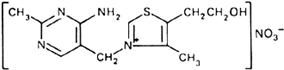
Chemical name. Thiamine nitrate (salt); 3-[(4-amino-2-methyl-5-pyrimidinyl)methyl]-5-(2-hydroxyethyl)-4-methylthiazolium nitrate (salt); CAS Reg. No. 532-43-4.
Description. Colourless crystals or a white, crystalline powder; odour, slight and characteristic.
Solubility. Sparingly soluble in water; very slightly soluble in ethanol (~750 g/l) TS.
Category. Component of vitamin B.
Storage. Thiamine mononitrate should be kept in a tightly closed, non-metallic container, protected from light.
Additional information. Even in the absence of light, Thiamine mononitrate is gradually degraded on exposure to a humid atmosphere, the decomposition being faster at higher temperatures.
Requirements
Definition. Thiamine mononitrate contains not less than 98.0% and not more than 101.0% of C12H17N5O4S, calculated with reference to the dried substance.
Identity tests
A. Dissolve 10 mg in 1 mL of water, add 1 mL of sodium hydroxide (~80 g/l) TS and 0.5 mL of potassium ferricyanide (10 g/l) TS; the solution remains pale yellow. Shake with 5 mL of 2-butanol R and allow to stand for 5-10 minutes; in bright daylight or in ultraviolet light (365 nm) the 2-butanol layer shows a blue fluorescence.
B. Spread a small quantity of the powder on a watch-glass; the odour is slight and characteristic, resembling that of yeast.
C. To 2 mL of a 0.05 g/mL solution add 2 mL of ferrous sulfate (15 g/l) TS; it yields reaction A described under 2.1 General identification tests as characteristic of nitrates.
Heavy metals. Use 1.0 g for the preparation of the test solution as described under 2.2.3 Limit test for heavy metals, Procedure 1; determine the heavy metals content according to Method A; not more than 20 μg/g.
Clarity and colour of solution. A solution of 0.2 g in 10 mL of water is clear and not more intensely coloured than standard colour solution Yw2 when compared as described under 1.11.1 Colour of liquids.
Sulfated ash. Not more than 1.0 mg/g.
Loss on drying. Dry to constant weight at 105°C; it loses not more than 10 mg/g.
pH value. pH of a 20 mg/mL solution, 6.0-7.5.
Assay. Dissolve about 0.1 g, accurately weighed, in 30 mL of glacial acetic acid R1, add 0.15 mL of l-naphtholbenzein/acetic acid TS, and titrate with perchloric acid (0.1 mol/l) VS to a green end-point, as described under 2.6 Non-aqueous titration, Method A. Each mL of perchloric acid (0.1 mol/l) VS is equivalent to 16.37 mg of C12H17N5O4S.
 |  |