Monographs: Pharmaceutical substances: Dolutegravir sodium (Dolutegravirum natricum)
Molecular formula. C20H18F2N3NaO5
Relative molecular mass. 441.37
Graphic formula
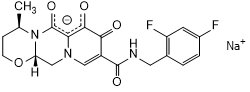
Chemical name. (4R,12aS)-N-[(2,4-Difluorophenyl)methyl]-7-hydroxy-4-methyl-6,8-dioxo-3,4,6,8,12,12a-hexahydro-2-H -pyrido[1',2':4,5]pyrazino[2,1-b][1,3]oxazine-9-carboxamide sodium salt (IUPAC), 2H-Pyrido[1',2':4,5]pyrazino[2,1-b][1,3]oxazine-9-carboxamide, N-[(2,4-difluorophenyl)methyl]-3,4,6,8,12,12a-hexahydro-7-hydroxy-4-methyl-6,8-dioxo-, sodium salt (1:1), (4R,12aS) (CAS); CAS Reg. No. 1051375-19-9.
Description. A white to pale yellow powder.
Solubility. Slightly soluble in water R, and very slightly soluble in methanol R.
Category. Antiretroviral (integrase strand-transfer inhibitor).
Storage. Dolutegravir sodium should be kept in a tightly closed container and protected from light and moisture.
Additional information. Dolutegravir sodium may exhibit polymorphism.
Definition. Dolutegravir sodium contains not less than 97.0% and not more than 102.0% ("Assay", method A) or not less than 99.0% and not more than 101.0% ("Assay", method B) of C20H18F2N3NaO5, calculated with reference to the anhydrous substance.
Identity tests
Either tests A, E and F or tests B, C, E and F or tests D, E and F may be applied.
-
Carry out the examination as described under 1.7 Spectrophotometry in the infrared region. The infrared absorption spectrum is concordant with the spectrum obtained from dolutegravir sodium RS or with the reference spectrum of dolutegravir sodium.
If the spectra thus obtained are not concordant repeat the test using the residues obtained by separately dissolving the test substance and dolutegravir sodium RS in a small amount of methanol R and evaporating to dryness. The infrared absorption spectrum of the test substance is concordant with the spectrum obtained from dolutegravir sodium RS.
-
Carry out the test as described under 1.14.1 Chromatography, High-performance liquid chromatography, using the conditions given under "Assay", method A. The retention time of the principal peak in the chromatogram obtained with solution (1) corresponds to the retention time of the peak due to dolutegravir in the chromatogram obtained with solution (2).
-
The absorption spectrum (1.6) of a 10 µg per mL solution of the test substance in methanol R, when observed between 220 nm and 400 nm, exhibits a maximum at about 258 nm.
Alternatively, in combination with identity test B, where a diode array detector is available, record the UV spectra of the principal peaks in the chromatograms with a diode array detector in the range of 220 nm to 400 nm. The UV spectrum of the principal peak in the chromatogram obtained with solution (1) corresponds to the UV spectrum of the peak due to dolutegravir in the chromatogram obtained with solution (2).
-
Carry out the test as described under 1.14.1 Chromatography, Thin-layer chromatography, using silica gel R6, or similar, as the coating substance and a mixture of 72 volumes of ethyl acetate R, 14 volumes of water R and 14 volumes of glacial acetic acid R as the mobile phase. Apply separately to the plate 5 μL of each of the following two test solutions in a mixture of 96 volumes of methanol R and 4 volumes of glacial acetic acid R containing (A) 1 mg of the test substance per mL and (B) 1 mg of dolutegravir sodium RS per mL. After removing the plate from the chromatographic chamber, allow it to dry in air or in a current of cool air. Examine the chromatogram in ultraviolet light (254 nm).
The principal spot obtained with solution (A) corresponds in position, appearance and intensity with the spot due to dolutegravir obtained with solution (B).
After drying, spray the plate with basic potassium permanganate (5 g/L) TS. Examine the chromatogram in daylight. The principal spot obtained with solution (A) corresponds in position, appearance and intensity with the spot due to dolutegravir obtained with solution (B).
-
Carry out test E.1 or, where HPLC and the indicated chiral columns are available, test E.2.
E.1 Determine the specific optical rotation (1.4) using a 5 mg/mL solution in dimethyl sulfoxide R and calculate with reference to the anhydrous substance;
 = –39 to –45.
E.2 Carry out the test as described under 1.14.1 Chromatography, High-performance liquid chromatography, using the conditions and solution (1) given under "Impurity A (dolutegravir enantiomer), impurity B and G." Prepare the following solutions using as the diluent a mixture of 50 volumes of acetonitrile R and 50 volumes of water R. For solution (2), dilute 5.0 mL of solution (1) to 100.0 mL. For solution (3), dissolve 5 mg of dolutegravir sodium RS to 100.0 mL. Inject 15 µL of solutions (2) and (3). The retention time of the principal peak obtained with solution (2) corresponds to the retention time of the peak due to dolutegravir in the chromatogram obtained with solution (3).
-
The test substance yields reaction A as described under 2.1 General identification tests as characteristic of sodium.
Heavy metals. Use 0.5 g for the preparation of the test solution as described under 2.2.3 Limit test for heavy metals, Procedure 5; determine the heavy metals content according to Method C; not more than 20 μg/g.
Water. Determine, as described under 2.8 Determination of water by the Karl Fischer method, Method A, using 0.300 g of the substance and a mixture of 90 volumes of methanol R and 10 volumes of glacial acetic acid R as the solvent; the water content is not more than 10 mg/g.
Impurity A (dolutegravir enantiomer), impurity B and G (dolutegravir diastereomers). Perform the test in subdued light and without any prolonged interruptions, using low-actinic glassware.
Carry out the test as described under 1.14.1 Chromatography, High-performance liquid chromatography, using a stainless steel column (25 cm x 4.6 mm) packed with particles of silica gel, the surface of which has been modified with cellulose tris (4-chloro-3-methylphenyl carbamate) (5 µm). As the mobile phase, use a mixture of 980 volumes of acetonitrile R, 40 volumes of water R and 2 volumes of phosphoric acid (~1440 g/L) TS.
Operate at a flow rate of 1.5 mL per minute. As a detector, use an ultraviolet spectrophotometer set at a wavelength of 258 nm. Maintain the column temperature at 25 °C.
Prepare the following solutions using as the diluent a mixture of 50 volumes of acetonitrile R and 50 volumes of water R. For solution (1), dissolve 50.0 mg of the test substance in 50.0 mL. For solution (2), dilute 5.0 mL of solution (1) to 100.0 mL. Dilute 3.0 mL of this solution to 100.0 mL. For solution (3), dissolve 5 mg of the test substance in 1 mL acetonitrile R. Add 4.5 mL water R and 4.5 mL hydrochloric acid (~ 420 g/L) TS and boil the solution under a reflux for 1 hour. Cool the solution to room temperature and dilute 1 mL of it to 10 mL with a mixture of 6 volumes of water R and 4 volumes of acetonitrile R. For solution (4), dissolve 2 mg of dolutegravir impurity D RS in 5 mL of acetonitrile R. Dilute 1 mL of this solution to 10 mL. For solution (5), dilute 2 mg of dolutegravir impurity B RS in 5 mL of acetonitrile R. Dilute 1 mL of this solution to 10 mL. For solution (6), mix 1 mL of solution (4) with 1.0 mL of solution (5).
Inject 15 µL of solutions (3) and (6). Record the chromatogram for about 45 minutes.
Use the chromatogram obtained with solution (3) to identify the peak due to impurity H. The chromatogram usually shows two principal peaks: the peak due to dolutegravir and the peak due to impurity H. Impurity G will elute at the same retention time as impurity H.
The impurities are eluted at the following relative retentions with reference to dolutegravir (retention time about 22 minutes): impurity H and impurity G: about 0.41; impurity A: about 0.72, impurity F: about 0.88; impurity D: about 1.27 and impurity B: about 1.39; impurity C: 1.62.
The test is not valid unless, in the chromatogram obtained with solution (6), the resolution between the peaks due to impurity D and due to impurity B is at least 1.5.
Inject 15 µL of solutions (1) and (2).
In the chromatogram obtained with solution (1):
-
the area of any peak corresponding to either impurity A or B is not greater than the area of the peak due to dolutegravir in the chromatogram obtained with solution (2) (0.15%).
-
Measure the area of the peak corresponding to impurity H and impurity G obtained in the chromatograms of solution (1) (impurity H and impurity G co-elute) and the area of the peak corresponding to dolutegravir obtained in the chromatograms of solution (2) and calculate the percentage content of the sum of impurity H and impurity G. Subtract the percentage content of impurity H determined using the method described under Related substances. The percentage content of impurity G is not greater than 0.15%.
Related substances. Perform the test in subdued light and without any prolonged interruptions, using low-actinic glassware. Carry out the test as described under 1.14.1 Chromatography, High-performance liquid chromatography, using a stainless steel column (25 cm x 4.6 mm) packed with particles of silica gel, the surface of which has been modified with chemically-bonded octadecylsilyl and pentafluorophenyl groups (5 µm).
Use the following conditions for gradient elution:
- Mobile phase A: 0.186 g of disodium edetate R in 1000 mL water R, adjusted to pH 2.0 with phosphoric acid (~20g/L) TS;
- Mobile phase B: 90 volumes of methanol R and 10 volumes of tetrahydrofuran R.
|
Time (minutes) |
Mobile phase A |
Mobile phase B |
Comments |
|
0–2 |
60 |
40 |
Isocratic |
|
2–32 |
60 to 50 |
40 to 50 |
Linear gradient |
|
32–56 |
50 to 20 |
50 to 80 |
Linear gradient |
|
56–62 |
20 |
80 |
Isocratic |
|
62–63 |
20 to 60 |
80 to 40 |
Return to initial composition |
|
63–70 |
60 |
40 |
Re-equilibration |
Operate at a flow rate of 1.0 mL per minute. As a detector, use an ultraviolet spectrophotometer set at a wavelength of 258 nm. Maintain the column temperature at 45 °C.
Prepare the following solutions using as the diluent a mixture of 60 volumes of water R and 40 volumes of acetonitrile R. For solution (1), dissolve 35.0 mg of the test substance and dilute to 50.0 mL. For solution (2), dilute 1.0 mL of solution (1) to 100.0 mL. For solution (3), dilute 5.0 mL of solution (2) to 50.0 mL. For solution (4), dilute 2 mg of dolutegravir impurity D RS in 5 mL of acetonitrile R. Dilute 1 mL of this solution to 10 mL. For solution (5), dissolve 5 mg of the test substance in 1 mL acetonitrile R. Add 4.5 mL water R and 4.5 mL hydrochloric acid (~ 420 g/L) TS and boil the solution under a reflux for 1 hour. Cool the solution to room temperature and dilute 1 mL of it to 10 mL with a mixture of 6 volumes of water R and 4 volumes of acetonitrile R. For solution (6), mix 1 mL of solution (4) with 1 mL of solution (5).
Inject 10 µL each of solutions (1), (2), (3), (4), (5) and (6).
Use the chromatogram obtained with solution (4) and the chromatogram supplied with dolutegravir impurity D RS to identify the peak due to impurity D. Use the chromatogram obtained with solution (5) to identify the peak due to impurity H (the chromatogram usually shows two principal peaks: the peak due to dolutegravir and the peak due to impurity H).
The impurities, if present, are eluted at the following relative retentions with reference to dolutegravir (retention time about 30 minutes): impurity C about 0.66; impurity F about 0.70; impurity D about 0.74; impurity H about 0.78; impurity E about 0.89; impurity J about 1.75; impurity K about 1.77; impurity L about 2.10.
The test is not valid unless, in the chromatogram obtained with solution (6), the resolution factor between the peaks due to impurity D and due to impurity H is at least 1.5. Also, the test is not valid unless, in the chromatogram obtained with solution (3), the peak due to dolutegravir is obtained with a signal-to-noise ratio of at least 20.
In the chromatogram obtained with solution (1):
-
the area of any peak corresponding to either impurities C, D, E, F, H, J, K or L is not greater than 1.5 times the area of the peak due to dolutegravir obtained with solution (3) (0.15%);
-
the area of any other impurity peak is not greater than the area of the peak due to dolutegravir obtained with solution (3) (0.10%).
-
The sum of the areas of all impurity peaks is not greater than the area of the peak due to dolutegravir obtained with solution (2) (1.0%). Disregard any peak with an area less than 0.5 times the area of the peak due to dolutegravir obtained with solution (3) (0.05%).
Assay. Perform the assay in subdued light and without any prolonged interruptions, using low-actinic glassware.
-
Either method A or method B may be applied.
-
Carry out test as described under 1.14.1 Chromatography, High-performance liquid chromatography using a stainless steel column (25 cm x 4.6 mm) packed with particles of silica gel, the surface of which has been modified with chemically-bonded octadecylsilyl and pentafluorophenyl groups (5 µm).
Use the following mobile phase: dissolve 0.186 g of disodium edetate R in 1000 mL water R and adjust to pH 2.0 with phosphoric acid (~20 g/L) TS. Mix 420 volumes of this solution with 580 volumes of methanol R.
Operate at a flow rate of 1.0 mL/minute. As a detector, use an ultraviolet spectrophotometer set at a wavelength of 258 nm. Maintain the column at a temperature of 40 °C.
Prepare the following solutions using as the diluent a mixture of 60 volumes of water R and 40 volumes of acetonitrile R.
For solution (1), dissolve 50.0 mg of the test substance and dilute to 100.0 mL. Dilute 5.0 mL of this solution to 50.0 mL. For solution (2), dissolve 50.0 mg of dolutegravir sodium RS and dilute to 100.0 mL. Dilute 5.0 mL of this solution to 50.0 mL.
Inject alternately 20 µL each of solutions (1) and (2). Record the chromatograms for about 25 minutes.
Measure the areas of the peaks corresponding to dolutegravir obtained in the chromatograms of solution (1) and (2) and calculate the percentage content of dolutegravir sodium (C20H18F2N3NaO5) using the declared content of C20H18F2N3NaO5 in dolutegravir sodium RS.
-
Dissolve about 0.300 g of the test substance in 30 mL of anhydrous acetic acid R and titrate with perchloric acid (0.1 mol/L) VS as described under 2.6 Non-aqueous titration, Method A. Each mL of perchloric acid (0.1 mol/L) VS is equivalent to 44.14 mg of C20H18F2N3NaO5.
Impurities
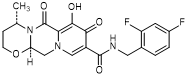
A. (4S,12aR)-N -[(2,4-difluorophenyl)methyl]-7-hydroxy-4-methyl-6,8-dioxo-3,4,6,8,12,12a-hexahydro-2H-pyrido[1',2':4,5]pyrazino[2,1-b][1,3]oxazine-9-carboxamide (dolutegravir enantiomer) (synthesis-related impurity).
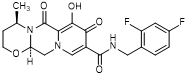
B. (4R,12aR)-N-[(2,4-difluorophenyl)methyl]-7-hydroxy-4-methyl-6,8-dioxo-3,4,6,8,12,12a-hexahydro-2H-pyrido[1',2':4,5]pyrazino[2,1-b][1,3]oxazine-9-carboxamide (dolutegravir diastereomer) (synthesis-related impurity).
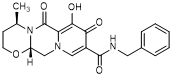
C. (4R,12aS)-N-benzyl-7-hydroxy-4-methyl-6,8-dioxo-3,4,6,8,12,12a-hexahydro-2H-pyrido[1', 2':4,5]pyrazino[2,1-b][1,3]oxazine-9-carboxamide; (desfluoro dolutegravir) (synthesis-related impurity).
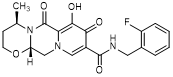
D. (4R,12aS)-N-[(2-fluorophenyl)methyl]-7-hydroxy-4-methyl-6,8-dioxo-3,4,6,8,12,12a-hexahydro-2H-pyrido[1', 2':4,5]pyrazino[2,1-b][1,3]oxazine-9-carboxamide; (2-fluoro dolutegravir) (synthesis-related impurity).
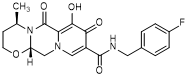
E. (4R,12aS)-N-[(4-fluorophenyl)methyl]-7-hydroxy-4-methyl-6,8-dioxo-3,4,6,8,12,12a-hexahydro-2H-pyrido[1',2':4,5]pyrazino[2,1-b][1,3]oxazine-9-carboxamide; (4-fluoro dolutegravir) (synthesis-related impurity).
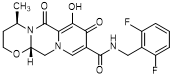
F. (4R,12aS)-N-[(2,6-difluorophenyl)methyl]-7-hydroxy-4-methyl-6,8-dioxo-3,4,6,8,12,12a-hexahydro-2H-pyrido[1',2':4,5]pyrazino[2,1-b][1,3]oxazine-9-carboxamide; (2,6-difluoro dolutegravir) (synthesis-related impurity).
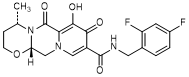
G. (4S,12aS)-N-[(2,4-difluorophenyl)methyl]-7-hydroxy-4-methyl-6,8-dioxo-3,4,6,8,12,12a-hexahydro-2H-pyrido[1',2':4,5]pyrazino[2,1-b][1,3]oxazine-9-carboxamide; (dolutegravir diastereomer)(synthesis-related impurity).
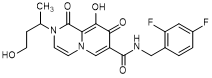
H. N-[(2,4-difluorophenyl)methyl]-9-hydroxy-2-[(2R)-4-hydroxybutan-2-yl]-1,8-dioxo-2,8-dihydro-1H-pyrido[1,2-a]pyrazine-7-carboxamide (synthesis-related impurity, degradation product).
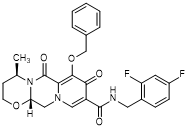
J. (4R,12aS)-N-[(2,4-difluorophenyl)methyl]-4-methyl-6,8-dioxo-7-(phenylmethoxy)-3,4,6,8,12,12a-hexahydro-2H-pyrido[1',2':4,5]pyrazino[2,1-b][1,3]oxazine-9-carboxamide (synthesis-related impurity).
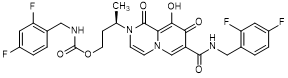
K. (3R)-3-(7-{[(2,4-difluorophenyl)methyl]carbamoyl}-9-hydroxy-1,8-dioxo-1,8-dihydro-2H-pyrido[1,2-a]pyrazin-2-yl)butyl [(2,4-difluorophenyl)methyl]carbamate (synthesis-related impurity).
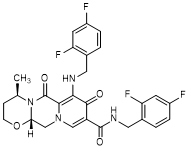
L. 4R,12aS)-N-[(2,4-difluorophenyl)methyl]-7-{[(2,4-difluorophenyl)methyl]amino}-4-methyl-6,8-dioxo-3,4,6,8,12,12a-hexahydro-2H-pyrido[1',2':4,5]pyrazino[2,1-b][1,3]oxazine-9-carboxamide (synthesis-related impurity).
 |  |