Monographs: Dosage forms: Specific monographs: Artemether and lumefantrine tablets (Artemetheri et lumefantrini compressi)
Category. Antimalarial.
Storage. Artemether and lumefantrine tablets should be kept in a well-closed container, protected from light.
Additional information. Strength in the current WHO Model list of essential medicines: 20 mg Artemether and 120 mg Lumefantrine.
Strength in the current WHO Model list of essential medicines for children: 20 mg Artemether and 120 mg Lumefantrine.
Requirements
Comply with the monograph for “Tablets”.
Definition. Artemether and lumefantrine tablets contain Artemether and Lumefantrine. They contain not less than 90.0% and not more than 110.0% of the amounts of artemether (C16H26O5) and lumefantrine (C30H32Cl3NO) stated on the label.
Identity tests
A. Carry out test A.1 or, where UV detection is not available, test A.2.
A.1 Carry out the test as described under 1.14.1 Chromatography, Thin-layer chromatography, using silica gel R6 as the coating substance and a mixture of 40 volumes of light petroleum R1, 10 volumes of ethyl acetate R and 5 volumes of glacial acetic acid R as the mobile phase. Apply separately to the plate 10 µl of each of the following two solutions in acetone R. For solution (A) shake a quantity of the powdered tablets containing about 10 mg of Artemether (about 60 mg of Lumefantrine) for 5 minutes with 10 mL, filter, and use the clear filtrate. For solution (B) use 1 mg of artemether RS and 6 mg of lumefantrine RS per mL. After removing the plate from the chromatographic chamber, allow it to dry exhaustively in air or in a current of cool air.
(i) Examine the chromatogram in ultraviolet light (254 nm).
The principal spot obtained with solution A corresponds in position, appearance, and intensity to that obtained with solution B (identifying lumefantrine).
(ii) Spray the plate with sulfuric acid/methanol TS. Heat the plate for 10 minutes at 140°C. Examine the chromatogram in daylight.
The principal spot obtained with solution A corresponds in position, appearance, and intensity to that obtained with solution B (identifying artemether; a faint spot due to lumefantrine may also be visible).
A.2 Carry out the test as described under 1.14.1 Chromatography, Thin-layer chromatography, using the conditions described above under test A.1 but using silica gel R5 as the coating substance After removing the plate from the chromatographic chamber, allow it to dry exhaustively in air or in a current of cool air. Spray with sulfuric acid/methanol TS. Heat the plate for 10 minutes at 140°C, allow it to cool and expose to iodine vapours for 20 minutes. Examine the chromatogram immediately in daylight.
The principal spots obtained with solution A correspond in position, appearance, and intensity to those obtained with solution B.
B. See the test described below under Assay. The retention times of the two principal peaks in the chromatogram obtained with solution (1) correspond to those in the chromatogram obtained with solution (2).
Artemether-related substances. Protect samples from light, also during chromatography.
Carry out the test as described under 1.14.1 Chromatography, Thin-layer chromatography, using silica gel R5 as the coating substance and a mixture of 40 volumes of light petroleum R1, 10 volumes of ethyl acetate R and 5 volumes of glacial acetic acid R as the mobile phase.
Prepare the following solutions in the solvent consisting of 1 volume of water R and 1 volume of acetonitrile R. For solution (1), weigh and powder 20 tablets. To a quantity of the powder containing 100 mg of Artemether add 20 mL of the solvent, sonicate for 15 minutes and centrifuge. Filter a portion of the supernatant through a 0.45-µm filter, discarding the first few mL of the filtrate. For solution (2) dissolve 5 mg of each of artemether RS, artenimol RS and α-artemether RS in 50 mL of the solvent. For solution (3) dilute 2.0 mL of solution (2) to 20 mL with the solvent. For solution (4) dilute 3.0 mL of solution (2) to 20 mL with the solvent. For solution (5) dilute 5.0 mL of solution (2) to 20 mL with the solvent. For solution (6) dilute 1.0 mL of solution (2) to 2 mL with the solvent. For solution (7) dilute 3.0 mL of solution (2) to 4 mL with the solvent.
Apply separately to the plate 20 µl of each of solutions (1), (3), (4), (5), (6) and (7). After application allow the spots to dry for 15 minutes in a current of cool air. Develop over a path of 12 cm. After removing the plate from the chromatographic chamber, allow it to dry exhaustively in air or in a current of cool air. Dip the plate in vanillin/sulfuric acid TS2. Heat the plate for 10 minutes at 140°C. Examine the chromatogram in daylight.
Artemether and related substances have the following Rf values: impurity A about 0.25; impurity B (artenimol) about 0.3; impurity C about 0.35; impurity D (α-artemether) about 0.4; artemether about 0.55. The test is not valid unless the chromatogram obtained with solution (3) shows three clearly separated spots.
In the chromatogram obtained with solution (1):
- any spot corresponding to impurity A is not more intense than the principal spot in the chromatogram obtained with solution (7) (1.5%),
- any spot corresponding to impurity B is not more intense than the spot due to artenimol in the chromatogram obtained with solution (6) (1.0%),
- any spot corresponding to impurity C is not more intense than the principal spot in the chromatogram obtained with solution (5) (0.5%),
- any spot corresponding to impurity D is not more intense than the spot due to α-artemether in the chromatogram obtained with solution (4) (0.3%),
- any other spot is not more intense than the principal spot in the chromatogram obtained with solution (3) (0.2%). Disregard any spot remaining at the point of application.
Assay. Carry out the test as described under 1.14.1 Chromatography, High-performance liquid chromatography, using a stainless steel column (15 cm x 3.9 mm) packed with particles of silica gel, the surface of which has been modified with chemically bonded octadecylsilyl groups (5 μm).
Use the following conditions for gradient elution:
Mobile phase A: 700 volumes of ion pair reagent and 300 volumes of acetonitrile R.
Mobile phase B: 300 volumes of ion pair reagent and 700 volumes of acetonitrile R.
Prepare the ion pair reagent by dissolving 5.65 g of sodium hexanesulfonate R and 2.75 g of sodium dihydrogen phosphate R in about 900 mL of water R. Adjust the pH to 2.3 using phosphoric acid (~105 g/l) TS, dilute to 1000 mL and filter through a 0.45-µm filter.
|
Time |
Mobile phase A |
Mobile phase B |
Comments |
|
0-28 |
60 |
40 |
Isocratic |
|
28-29 |
60 to 0 |
40 to 100 |
Linear gradient |
|
29-45 |
0 |
100 |
Isocratic |
|
45-46 |
0 to 60 |
100 to 40 |
Return to initial composition |
|
46-55 |
60 |
40 |
Isocratic re-equilibration |
Prepare the following solutions in the solvent which is obtained by mixing 200 mL of ion pair reagent, 60 mL of water R and 200 mL of 1-propanol R and diluting to 1000 mL with acetonitrile R. Prepare and keep both solutions at a temperature not below 20°C. For solution (1), weigh and powder 20 tablets. Transfer a quantity of the powder containing about 20 mg of Artemether (about 120 mg of Lumefantrine), accurately weighed, to a 100-mL volumetric flask. Add approximately 85 mL of the solvent, sonicate for 20 minutes, allow to cool to room temperature and dilute to volume with the solvent. Filter through a 0.45 µm-filter, discarding the first few mL of the filtrate. For solution (2), accurately weigh 20 mg of artemether RS and 120 mg of lumefantrine RS in a 100 mL volumetric flask. Add approximately 85 mL of solvent, sonicate until dissolved, allow to cool to room temperature and dilute to volume.
Operate with a flow rate of 1.3 mL per minute. As a detector use an ultraviolet spectrophotometer set at a wavelength of about 210 nm for the first 28 minutes and then switch to about 380 nm.
Inject alternately 20 µl each of solutions (1) and (2). (The peak for artemether is eluted at a retention time of approximately 19 minutes, and that for lumefantrine at a retention time of approximately 34 minutes.)
Measure the areas of the peak responses obtained in the chromatograms from solutions (1) and (2), and calculate the content of artemether (C16H26O5) and lumefantrine (C30H32Cl3NO) in the tablets.
Impurities.
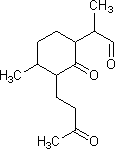
A. 2-[4-methyl-2-oxo-3-(3-oxobutyl)cyclohexyl]propanal,
B. artenimol,
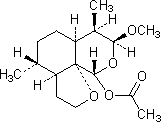
C. (3aS,4R,6aS,7R,8S,10R,10aR)-8-methoxy-4,7-dimethyloctahydro-2H-furo[3,2-i][2]benzopyran-10-yl acetate,
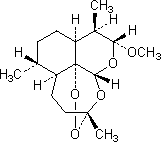
D. (3R,5aS,6R,8aS,9R,10R,12R,12aR)-10-methoxy-3,6,9-trimethyldecahydro-3,12-epoxy-12H-pyrano[4,3-j]-1,2-benzodioxepine (α-artemether).
 |  |