Monographs: Pharmaceutical substances: Propylthiouracil (Propylthiouracilum)
Molecular formula. C7H10N2OS
Relative molecular mass. 170.2
Graphic formula
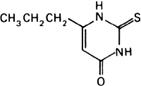
Chemical name. 6-Propyl-2-thiouracil; 2,3-dihydro-6-propyl-2-thioxo-4(1H)-pyrimidinone; 6-propyl-2-thio-2,4(1H,3H)-pyrimidinedione; CAS Reg. No. 51-52-5.
Description. Colourless or pale cream-coloured crystals or a white or cream-coloured, crystalline powder; odourless.
Solubility. Very slightly soluble in water; sparingly soluble in ethanol (~750 g/L) TS; slightly soluble in ether R.
Category. Antithyroid substance.
Storage. Propylthiouracil should be kept in a well-closed container, protected from light.
Additional information. Propylthiouracil has a bitter taste.
Requirements
Definition. Propylthiouracil contains not less than 98.0% and not more than 100.5% of C7H10N2OS, calculated with reference to the dried substance.
Identity tests
-
Either test A alone or tests B, C, and D may be applied.
-
Carry out the examination as described under 1.7 Spectrophotometry in the infrared region. The infrared absorption spectrum is concordant with the spectrum obtained from propylthiouracil RS or with the reference spectrum of propylthiouracil.
-
Dissolve 0.05 g in 5 mL of boiling water and, to the hot solution, add a freshly prepared solution of 20 mg of hydroxylamine hydrochloride R and 0.04 g of anhydrous sodium carbonate R in 5 mL of water, to which 0.4 mL of sodium nitroprusside (45 g/L) TS has been added; a greenish blue colour is produced.
-
To 25 mg, add bromine TS1, drop by drop, until the substance is completely dissolved. Warm until the colour is discharged, cool, and add 10 mL of barium hydroxide (15 g/L) TS; a white precipitate is produced (distinction from thiouracil, which yields a white precipitate that turns purple within 1 minute).
-
Melting temperature, about 220 °C.
Heavy metals. Use 1.0 g for the preparation of the test solution as described under 2.2.3 Limit test for heavy metals. Procedure 3; determine the heavy metals content according to Method A; not more than 20 μg/g.
Sulfated ash. Not more than 1.0 mg/g.
Loss on drying. Dry to constant weight at 105 °C; it loses not more than 5.0 mg/g.
Thiourea. Boil 0.50 g with 50 mL of water under a reflux condenser until dissolved and dilute 5 mL of the hot solution to 50 mL with water. Place 10 mL of this solution in a test-tube and add to it 1 mL of thiourea (0.1 g/L) TS. Cool the remainder of the hot solution, filter and place 10 mL of the filtrate in a second test-tube, to serve as a reference. To each tube, add 0.5 g of sodium acetate R and 5 mL of silver nitrate (0.1 mol/L) VS and heat in a water-bath for 5 minutes. The colour produced in the test solution, when viewed transversely against a white background, is not more intense than that of the reference solution when compared as described under 1.11.1 Colour of liquids.
Assay. Transfer about 0.3 g, accurately weighed, to a 500 mL flask and add 30 mL of water. Add from a burette about 30 mL of sodium hydroxide (0.1 mol/L) VS, heat to boiling, and shake the flask until solution is complete. Wash down any particles on the wall of the flask with a small volume of water, then add about 50 mL of silver nitrate (0.1 mol/L) VS while mixing, and boil gently for 5 minutes. Add 1-2 mL of bromothymol blue/ethanol TS and continue to titrate with sodium hydroxide (0.1 mol/L) VS until a permanent blue-green colour is produced. Each mL of sodium hydroxide (0.1 mol/L) VS is equivalent to 8.51 mg of C7H10N2OS.
 |  |