Monographs: Pharmaceutical substances: Acetazolamide (Acetazolamidum)
Molecular formula. C4H6N4O3S2
Relative molecular mass. 222.2
Graphic formula.
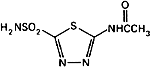
Chemical name. N-(5-Sulfamoyl-1,3,4-thiadiazol-2-yl)acetamide; N-[5-(aminosulfonyl)-1,3,4-thiadiazol-2-yl]acetamide; 5-acetamido-1,3,4-thiadiazole-2-sulfonamide; CAS Reg. No. 59-66-5.
Description. A white, or almost white, crystalline powder; odourless.
Solubility. Very slightly soluble in water; slightly soluble in ethanol (~750 g/l) TS; practically insoluble in ether R.
Category. Carbonic anhydrase inhibitor.
Storage. Acetazolamide should be kept in a well-closed container.
Requirements
Definition. Acetazolamide contains not less than 99.0% and not more than 101.0% of C4H6N4O3S2, calculated with reference to the dried substance.
Identity tests
A. Carry out the examination as described under 1.7 Spectrophotometry in the infrared region. The infrared absorption spectrum is concordant with the spectrum obtained from acetazolamide RS or with the reference spectrum of acetazolamide.
B. Dissolve 25 mg in 5 mL of water, add 0.15 mL of sodium hydroxide (1 mol/l) VS and 0.1 mL of copper(II) sulfate (80 g/l) TS; a bluish green colour or precipitate is formed.
C. Triturate 0.5 g with a mixture of 5 mL of water and 1 mL of sodium hydroxide (1 mol/l) VS, add 0.2 g of zinc R powder and 0.5 mL of hydrochloric acid (~420 g/l) TS; hydrogen sulfide is evolved and may be detected by its odour (proceed with caution), or by the use of filter paper soaked in lead acetate (80 g/l) TS which turns black on exposure.
Heavy metals. Use 1.0 g for the preparation of the test solution as described under 2.2.3 Limit test for heavy metals, Procedure 3; determine the heavy metal content according to Method A; not more than 20 μg/g.
Sulfates. Dissolve 1.0 g in 40 mL of water, warm to 70°C for 5 minutes, cool and filter. Proceed with the filtrate as described under 2.2.2 Limit test for sulfates; the sulfate content is not more than 0.5 mg/g.
Sulfated ash. Not more than 1.0 mg/g.
Loss on drying. Dry to constant weight at 105°C; it loses not more than 5.0 mg/g.
pH value. Shake 1 g with 50 mL of water for 5 minutes; pH of the suspension, 4.0-6.0.
Related substances. Carry out the test as described under 1.14.1 Chromatography, Thin-layer chromatography, using silica gel R2 as the coating substance and a mixture of 30 volumes of dioxan R, 30 volumes of 2-propanol R, 20 volumes of ammonia (~35 g/l) TS, 10 volumes of toluene R, and 10 volumes of xylene R as the mobile phase. Apply separately to the plate 20 μl of each of 2 solutions in ethanol (~750 g/l) TS containing (A) 5.0 mg of the test substance per mL and (B) 0.050 mg of the test substance per mL. After removing the plate from the chromatographic chamber, allow it to dry in air, and examine the chromatogram in ultraviolet light (254 nm). Any spot obtained with solution A, other than the principal spot, is not more intense than that obtained with solution B.
Assay. Dissolve about 0.45 g, accurately weighed, in 90 mL of dimethylformamide R and titrate with tetrabutylammonium hydroxide (0.1 mol/l) VS determining the end-point potentiometrically as described under 2.6 Non-aqueous titration, Method B. Each mL of tetrabutylammonium hydroxide (0.1 mol/l) VS is equivalent to 22.22 mg of C4H6N4O3S2.
 |  |