Monographs: Pharmaceutical substances: 2-Propanol (2-Propanolum)
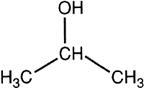
C3H8O
Relative molecular mass. 60.10
Chemical name. Isopropyl alcohol; 2-propanol; CAS Reg. No. 67-63-0.
Description. A colourless, clear, and mobile liquid; odour, characteristic.
Miscibility. Miscible with water, ethanol (~750 g/l) TS and ether R.
Category. Solvent; antiseptic.
Storage. 2-Propanol should be kept in a tightly closed container.
Additional information. 2-Propanol is volatile and flammable. Boiling range, 81-83 °C.
Requirements
Identity tests
A. Mix 1 mL with 9 mL of water. To 1 mL of this solution add 2 mL of mercuric sulfate TS and heat to boiling; a white to yellowish white precipitate is produced.
B. Heat gently 1 mL with 3 mL of potassium dichromate (100 g/l) TS and 1 mL of sulfuric acid (~1760 g/l) TS; acetone, perceptible by its odour, is evolved.
Refractive index.  = 1.376 - 1.378.
Relative density.  = 0.783 - 0.787
Nonvolatile residue. Evaporate 50 mL to dryness on a water-bath, heat at 105 °C for 1 hour, and weigh; not more than 2.5 mg (0.005%).
Acidity. To 50 mL add 100 mL of carbon-dioxide-free water R and 2 drops of phenolphthalein/ethanol TS, and titrate with carbonate-free sodium hydroxide (0.02 mol/l) VS to a pink colour that persists for 30 seconds; not more than 0.7 mL of carbonate-free sodium hydroxide (0.02 mol/l) VS is required.
Aldehydes and ketones. Transfer 25 mL to a comparison tube, add 25 mL of water and 50 mL of hydroxylamine hydrochloride TS, mix, and allow to stand for 5 minutes. Titrate with sodium hydroxide (0.1 mol/l) VS until the colour matches that of 50 mL of hydroxylamine hydrochloride TS placed in a similar tube and viewed down the vertical axis; not more than 2.0 mL of sodium hydroxide (0.1 mol/l) VS is required.
 |  |