Monographs: Pharmaceutical substances: Nifedipine (Nifedipinum)
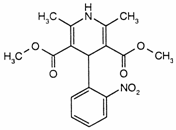
C17H18N2O6
Relative molecular mass. 346.3
Chemical name. 1,4-Dihydro-2,6-dimethyl-4-(o-nitrophenyl)-3,5-pyridinedicarboxylate dimethyl ester; 1,4-dihydro-2,6-dimethyl-4-(2-nitrophenyl)-3,5- pyridinedicarboxylic acid dimethyl ester; CAS Reg. No. 21829-25-4.
Description. A yellow, crystalline powder.
Solubility. Nifedipine is practically insoluble in water; freely soluble in acetone R; sparingly soluble in dehydrated ethanol R.
Category. Cardiovascular drug; calcium-channel blocking agent.
Storage. Nifedipine should be kept in a tightly closed container, protected from light.
Additional information. CAUTION: Nifedipine decomposes on exposure to daylight, artificial light of certain wavelengths, and ultraviolet light.
Requirements
Nifedipine contains not less than 98.0% and not more than 102.0% of C17H18N2O6, calculated with reference to the dried substance.
Note: Throughout the monograph perform the tests and the assay in the dark or under a suitable fluorescent light, using low-actinic glassware.
Identity tests
• Either tests A and D or tests B, C, and D may be applied.
A. Carry out the examination as described under 1.7 Spectrophotometry in the infrared region. The infrared absorption spectrum is concordant with the spectrum obtained from nifedipine RS or with the reference spectrum of nifedipine.
B. See the test described below under "Related substances, Test B". The principal spot obtained with solution A corresponds in position, appearance, and intensity with that obtained with solution B.
C. Using gentle heat dissolve 25 mg in 10 mL of a mixture of 5 volumes of ethanol (~750 g/l) TS, 3.5 volumes of water, and 1.5 volumes of hydrochloric acid (~420 g/l) TS. Add 0.5 g of granulated zinc R and allow to stand for 5 minutes, swirling occasionally, and filter. To the filtrate add 5 mL of sodium nitrite (10 g/l) TS and allow to stand for 2 minutes. Add 2.0 mL of ammonium sulfamate (50 g/l) TS, shake vigorously but carefully, and add 2.0 mL of N-(1-naphthyl)ethylenediamine hydrochloride (5 g/l) TS; an intense red colour is produced which does not fade within 5 minutes.
D. Melting temperature, about 173 °C.
Sulfated ash. Use an ignition temperature of 600 °C; not more than 1.0 mg/g.
Loss on drying. Dry at 105 °C for 2 hours; it loses not more than 5.0 mg/g.
Related substances
• Either test A or test B may be applied.
A. Carry out the test as described under 1.14.1 Chromatography, High-performance liquid chromatography, using a stainless steel column (15 cm × 4.6 mm) packed with particles of silica gel, the surface of which has been modified with chemically bonded octadecylsilyl groups (5-10 μm). As the mobile phase, use a mixture of 55 volumes of water, 36 volumes of methanol R, and 9 volumes of acetonitrile R.
Prepare the following solutions in methanol R: for solution (A) dissolve 0.20 g of Nifedipine in 20 mL of methanol R and dilute to 50 mL with the mobile phase; solution (B) 0.4 mg of dimethyl 2,6-dimethyl-4-(2-nitrophenyl) pyridine-3,5-dicarboxylate RS per mL; solution (C) 0.4 mg of dimethyl 2,6-dimethyl-4-(2-nitrosophenyl)pyridine-3,5-dicarboxylate RS 120 per mL; and for solution (D) mix 1.0 mL each of solutions B and C and 0.10 mL of solution A, dilute to 20 mL with the mobile phase, then dilute 2.0 mL of the resulting solution to 10 mL with the mobile phase.
Operate with a flow rate of 1.0 mL per minute. As a detector use an ultraviolet spectrophotometer set at a wavelength of about 235 nm; the use of an electronic integrator is advisable.
Inject 20 μl of solution D. The peaks are eluted in the following order: dimethyl 2,6-dimethyl-4-(2-nitrophenyl)pyridine-3,5-dicarboxylate; dimethyl 2,6-dimethyl-4-(2-nitrosophenyl)pyridine-3,5-dicarboxylate; and nifedipine. The retention time of nifedipine is about 15.5 minutes.
The test is not valid unless, in the chromatogram obtained with solution D:
- the resolution between the peaks corresponding to dimethyl 2,6- dimethyl-4-(2-nitrophenyl)pyridine-3,5-dicarboxylate and dimethyl 2,6- dimethyl-4-(2-nitrosophenyl)pyridine-3,5-dicarboxylate is greater than 1.5; and
- the resolution between the peaks corresponding to dimethyl 2,6-dimethyl-4-(2-nitrosophenyl)pyridine-3,5-dicarboxylate and nifedipine is greater than 1.5.
Adjust the sensitivity of the system so that the height of the peak corresponding to dimethyl 2,6-dimethyl-4-(2-nitrophenyl)pyridine-3,5- dicarboxylate is not less than 20% of the full scale of the recorder.
Inject alternately 20 μl each of solutions A and D. Record the chromatogram for twice the retention time of nifedipine.
Measure the areas of the peak responses obtained in the chromatograms from solutions A and D, and calculate the content of the related substances as a percentage. In the chromatogram obtained with solution A, none of the peaks, other than the principal peak and the peaks corresponding to dimethyl 2,6-dimethyl-4-(2-nitrophenyl)pyridine-3,5-dicarboxylate and dimethyl 2,6-dimethyl-4-(2-nitrosophenyl)pyridine-3,5-dicarboxylate, has an area greater than that of the peak corresponding to nifedipine in the chromatogram obtained with solution D (0.1%). The areas of the peaks corresponding to dimethyl 2,6-dimethyl-4-(2-nitrophenyl)pyridine-3,5-dicarboxylate and dimethyl 2,6-dimethyl-4-(2-nitrosophenyl)pyridine-3,5-dicarboxylate are not greater than the corresponding peaks in the chromatogram obtained with solution D (0.1%). The total amount of related substances does not exceed 0.3%. Disregard any peak with an area less than 10% of the area of the peak corresponding to nifedipine in the chromatogram obtained with solution D (0.01%).
B. Carry out the test as described under 1.14.1 Chromatography, Thin-layer chromatography, in an unsaturated chamber, using silica gel R6 as the coating substance and a mixture of 6 volumes of cyclohexane R and 4 volumes of ethyl acetate R as the mobile phase. Apply separately to the plate 5 μl of each of 3 solutions in methanol R containing (A) 1.0 μg of Nifedipine per mL, (B) 1.0 mg of nifedipine RS per mL, and (C) 10 μg of Nifedipine per mL. After removing the plate from the chromatographic chamber, allow it to dry in air, and examine the chromatogram in ultraviolet light (254 nm).
Any spot obtained with solution A, other than the principal spot, is not more intense than that obtained with solution C (1.0%).
Assay. Dissolve about 0.13 g, accurately weighed, in a mixture of 25 mL of tert-butanol R and 25 mL of perchloric acid TS, and titrate with ceric ammonium sulfate (0.1 mol/l) VS, using 0.1 mL of ferroin TS as indicator until the pink colour is discharged, titrating slowly towards the end-point. Repeat the procedure without the Nifedipine being examined and make any necessary corrections.
Each mL of ceric ammonium sulfate (0.1 mol/l) VS is equivalent to 17.32 mg of C17H18N2O6.
 |  |