Monographs: Pharmaceutical substances: Antimony sodium tartrate (Stibii natrii tartras)
Molecular formula. C4H4NaO7Sb
Relative molecular mass. 308.8
Graphic formula.
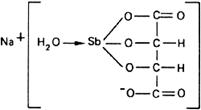
Chemical name. Sodium aqua[tartrato(4-)-O1,O2,O3]antimoniate(III); CAS Reg. No. 34521-09-0.
Description. Colourless, transparent scales or an almost white powder; odourless.
Solubility. Soluble in 1.5 parts of water; practically insoluble in ethanol (~750 g/l) TS.
Category. Antischistosomal drug.
Storage. Antimony sodium tartrate should be kept in a tightly closed container, protected from light.
Additional information. Antimony sodium tartrate is hygroscopic. Even in the absence of light, it is gradually degraded on exposure to a humid atmosphere, the decomposition being faster at higher temperatures.
Requirements
Definition. Antimony sodium tartrate contains not less than 98.0% and not more than 101.0% of C4H4NaO7Sb, calculated with reference to the dried substance.
Identity tests
A. When tested for sodium as described under 2.1 General identification tests, yields the characteristic reactions. If reaction B is to be used, prepare a 10 mg/mL solution.
B. Dissolve 0.05 g in 1.0 mL of hydrochloric acid (~70 g/l) TS and add 1.0 mL of hydrogen sulfide TS; an orange-red precipitate is produced, which is soluble in ammonium sulfide TS and in sodium hydroxide (~80 g/l) TS.
C. Dissolve 20 mg in 0.2 mL of water; it yields reaction B described under 2.1 General identification tests, as characteristic of tartrates.
Arsenic. Dissolve 1.3 g in 10 mL of water and add 16 mL of stannated hydrochloric acid (~250 g/l) AsTS in a flask, connect to a condenser, and distil 20 mL; wash the flask and condenser, return the distillate and washings to the flask, add 0.05 mL of stannous chloride AsTS, and redistil 16 mL; proceed with the distillate as described under 2.2.5 Limit test for arsenic; the arsenic content is not more than 8 μg/g.
Clarity and colour of solution. A solution of 0.50 g in 10 mL of water is clear and colourless.
Loss on drying. Dry to constant weight at 105°C; it loses not more than 60 mg/g.
Acidity or alkalinity. Dissolve 1.0 g in 50 mL of water and add a few drops of bromocresol green/ethanol TS; not more than 2 mL of either hydrochloric acid (0.01 mol/l) VS or sodium hydroxide (0.01 mol/l) VS are required to obtain the midpoint of the indicator (green) indicative of pH 4.5.
Assay. Dissolve about 0.5 g, accurately weighed, in 50 mL of water, add 5 g of potassium sodium tartrate R and 2 g of sodium tetraborate R. Titrate with iodine (0.05 mol/l) VS using starch TS as indicator, added towards the end of the titration. Each mL of iodine (0.05 mol/l) VS is equivalent to 15.44 mg of C4H4NaO7Sb.
 |  |