Monographs: Pharmaceutical substances: Amphotericin B (Amphotericinum B)
Amphotericin B for parenteral use
Molecular formula. C47H73NO17
Relative molecular mass. 924.1
Graphic formula.
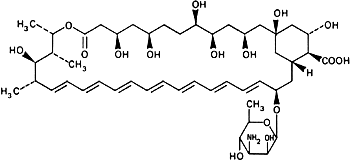
Chemical name. (1R,3S,5R,6R,9R,11R,15S,16R,17R,18S,19E,21E,23E,25E,27E,29E,31E,33R,35S,36R,37S)-33-[(3-Amino-3,6-dideoxy-β-D-mannopyranosyl)-oxy]-1,3,5,6,9,11,17,37-octahydroxy-15,16,18-trimethyl-13-oxo-14,39-dioxa-bicyclo[33.3.1]nonatriaconta-19,21,23,25,27,29,31-heptaene-36-carboxylic acid; [1R-(1R*,3S*,5R*,6R*,9R*,11R*,15S*,16R*,17R*,18S*,19E,21E,23E,25E,27E,29E,31E,33R*,35S*,36R*,37S*)]-33-[(3-amino-3,6-dideoxy-β-D-mannopyranosyl)oxy]-1,3,5,6,9,11,17,37-octahydroxy-15,16,18-trimethyl-13-oxo-14,39-dioxabicyclo[33.3.1]nonatriaconta-19,21,23,25,27,29,31-heptaene-36-carboxylic acid; (3R,5R,8R,9R,11S,13R,15S,16R,17S,19R,34S,35R,36R,37S)-19-(3-amino-3,6-dideoxy-β-D-mannopyranosyloxy)-16-carboxy-3,5,8,9,11,13,15,35-octahydroxy-34,36-dimethyl-13,17-epoxyoctatriaconta-20,22,24,26,28,30,32-heptaen-37-olide; CAS Reg. No. 1397-89-3.
Description. A yellow to orange powder; odourless or almost odourless.
Solubility. Practically insoluble in water, ethanol (~750 g/l) TS, toluene R and ether R; soluble in 200 parts of dimethylformamide R and in 20 parts of dimethyl sulfoxide R, slightly soluble in methanol R.
Category. Antifungal drug.
Storage. Amphotericin B should be kept in a tightly closed container, protected from light, and stored at a temperature between 2 and 8 °C.
Labelling. The designation Amphotericin B for parenteral use indicates that the substance complies with the altered and additional requirements for Amphotericin B and may be used for parenteral administration.
Additional information. Even in the absence of light, Amphotericin B is gradually degraded on exposure to a humid atmosphere, the decomposition being faster at higher temperatures. In diluted solutions it is sensitive to light and is inactivated at low pH values.
Requirements
Definition. Amphotericin B contains not less than 750 μg per mg, calculated with reference to the dried substance.
Identity tests
A. Dissolve 25 mg in 5 mL of dimethyl sulfoxide R, add sufficient methanol R to produce 50 mL, and dilute 2.0 mL to 200 mL with methanol R. The absorption spectrum of the resulting solution, when observed between 300 nm and 450 nm, exhibits 3 maxima at about 362 nm, 381 nm, and 405 nm. The ratio of the absorbance of a 1-cm layer at 362 nm to that at 381 nm is about 0.6; the ratio of the absorbance at 381 nm to that at 405 nm is about 0.9.
B. Dissolve about 1 mg in 2.0 mL of dimethyl sulfoxide R and introduce 5 mL of phosphoric acid (~1440 g/l) TS to form a lower layer; a blue ring is immediately formed at the interface of the two liquids. Mix the two liquids; a strong blue colour is produced. Add 15 mL of water and mix; the colour of the solution changes to pale yellow.
Sulfated ash. Not more than 30 mg/g.
Loss on drying. Dry to constant weight at 60 °C under reduced pressure (not exceeding 0.6 kPa or about 5 mm of mercury); it loses not more than 50 mg/g.
Content of tetraenes. Dissolve 0.05 g, accurately weighed, in 5 mL of dimethyl sulfoxide R, and add sufficient methanol R to produce 50 mL; dilute 4 mL to 50 mL with methanol R (solution A). For the reference solutions dissolve similarly 0.05 g, accurately weighed, of amphotericin B RS instead of the substance being examined (solution B). Further prepare a solution of 25 mg of nystatin RS, accurately weighed, in 25 mL of dimethyl sulfoxide R, and add sufficient methanol R to produce 250 mL; dilute 4 mL to 50 mL with methanol R (solution C). Measure the absorbances of a 1-cm layer of solutions A, B, and C at the maxima at about 282 nm and 304 nm, using as a blank a solution of 5 mL of dimethyl sulfoxide R diluted to 50 mL with methanol R, 4 mL of which are diluted once again to 50 mL with methanol R.
Calculate the  of solutions A, B, and C at both wavelengths and then apply the following formula: F+1000(B1A2-B2A1)/(C2B1-C1B2), where A1 and A2 are the of the substance being examined at 282 nm and 304 nm, respectively, B1 and B2 are the of amphotericin B RS at 282 nm and 304 nm, respectively, C1 and C2 are the of nystatin RS at 282 nm and 304 nm, respectively, and F is the declared content of tetraenes in amphotericin B RS; the content of tetraenes in the substance examined is not more than 150 mg/g.
Assay. Triturate 0.060 g with dimethylformamide R and add, with shaking, sufficient dimethylformamide R to produce 100 mL. Dilute 10 mL to 100 mL with dimethylformamide R and carry out the assay as described under 3.1 Microbiological assay of antibiotics, using Saccharomyces cerevisiae (NCTC 10716, or ATCC 9763) as the test organism, culture medium Cm3 with a final pH of 6.1, sterile phosphate buffer pH 10.5, TS1, an appropriate concentration of amphotericin B (usually between 0.5 and 10.0 μg/mL), and an incubation temperature of 29-33 °C. The precision of the assay is such that the fiducial limits of error of the estimated potency (P = 0.95) are not less than 95% and not more than 105% of the estimated potency. The upper fiducial limit of error of the estimated potency (P = 0.95) is not less than 750 μg per mg, calculated with reference to the dried substance.
Additional requirements for Amphotericin B for parenteral use
Complies with the monograph for "Parenteral preparations".
Sulfated ash. Not more than 5.0 mg/g.
Content of tetraenes. Not more than 100 mg/g.
Bacterial endotoxins. Carry out the test as described under 3.4 Test for bacterial endotoxins; contains not more than 0.9 IU of endotoxin RS per mg.
 |  |