Monographs: Pharmaceutical substances: Fluconazole (Fluconazoli)
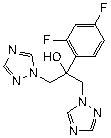
C13H12F2N6O
Relative molecular mass. 306.3
Chemical name. 2-(2,4-Difluorophenyl)-1,3-bis(1H-1,2,4-triazol-1-yl)propan-2-ol; CAS Reg. No.86386-73-4.
Description. A white or almost white, crystalline powder.
Solubility. Slightly soluble in water, freely soluble in methanol, soluble in acetone.
Category. Antifungal.
Storage. Fluconazole should be kept in a tightly closed container.
Additional information. Fluconazole is hygroscopic and exhibits polymorphism.
Requirements
Definition . Fluconazole contains not less than 99.0% and not more than 101.0% of C13H12F2N6O, calculated with reference to the dried substance.
Identity tests
- Either test A alone or tests B and C may be applied.
A. Carry out the examination as described under 1.7 Spectrophotometry in the infrared region. The infrared absorption spectrum is concordant with the spectrum obtained from fluconazole RS or with the reference spectrum of fluconazole. If the spectra thus obtained are not concordant repeat the test using the residues obtained by separately dissolving the test substance and fluconazole RS in a small amount of dichloromethane R and evaporating to dryness. The infrared absorption spectrum is concordant with the spectrum obtained from fluconazole RS.
B. Carry out the test as described under 1.14.1 Chromatography, Thin-layer chromatography using silica gel R6 as the coating substance and a mixture of 80 volumes of dichloromethane R, 20 volumes of methanol R and 1 volume of ammonia (~260 g/l) TS as the mobile phase. Apply separately to the plate 10 μl of each of the following three solutions in methanol R. For solution (A) use 10 mg of the test substance per mL. For solution (B) use 10 mg of fluconazole RS per mL. For solution (C) use a solution containing 2 mg of fluconazole RS per mL and 1 mg of ketoconazole RS per mL. After removing the plate from the chromatographic chamber allow it to dry in a current of air and examine the chromatogram in ultraviolet light (254 nm).
The principal spot obtained with solution (A) corresponds in position, appearance and intensity with that obtained with solution (B). The test is not valid unless the chromatogram obtained with solution (C) shows two clearly separated spots.
C. The absorption spectrum (1.6) of a 0.2 mg/mL solution in ethanol R, when observed between 230 nm and 300 nm, exhibits maxima at about 261 nm and 267 nm and a minimum at about 264 nm; the ratio of the absorbance of a 1 cm layer at the maximum at about 261 nm to that at the minimum at about 264 is about 1.4.
Clarity and colour of solution. A solution of 1.0 g in 20 mL of methanol R is clear and colourless.
Heavy metals
- Either test A or test B may be applied.
A. Use 1.0 g for the preparation of the test solution as described under 2.2.3 Limit test for heavy metals, Procedure 3; determine the heavy metals content according to Method A; not more than 10 μg/g.
B. Use 1.0 g for the preparation of the test solution in methanol as described under 2.2.3 Limit test for heavy metals, Procedure 2; determine the heavy metals content according to Method A; not more than 10 μg/g.
Sulfated ash (2.3). Not more than 1.0 mg/g using Method B and a platinum crucible.
Loss on drying. Dry to constant weight at 105 °C; it loses not more than 5 mg/g.
Related substances
Carry out the test as described under 1.14.1 Chromatography, High-performance liquid chromatography using a stainless steel column (25 cm × 4.6 mm) packed with particles of silica gel, the surface of which has been modified with chemically-bonded octadecylsilyl groups (5 µm). As the mobile phase use a mixture of 86 volumes of a (0.63 g/l) solution of ammonium formate R and 14 volumes of acetonitrile R
Prepare the following solutions in the mobile phase. For solution (1) use 10 mg of the test substance per mL. For solution (2) dilute 5 mL of solution (1) to 100 mL then dilute l mL of this solution to 10 mL. For solution (3) use 0.1 mg of fluconazole impurity C RS per mL. For solution (4) transfer 1.0 mL of solution (3) to a 10 mL volumetric flask, add 1.0 mL of solution (1) and make up to volume.
Operate with a flow rate of 1.0 mL per minute. As a detector use an ultraviolet spectrophotometer set at a wavelength of 260 nm.
Inject separately 20 µl each of solutions (1), (2), (3) and (4). Record the chromatograms for about 3.5 times the retention time of fluconazole.
The peaks are eluted at the following relative retentions with reference to fluconazole (retention time about 11 minutes): impurity B about 0.4; impurity A about 0.5; impurity C about 0.8.
The test is not valid, unless in the chromatogram obtained with solution (4), the resolution between the peaks due to impurity C and fluconazole is at least 3.0
In the chromatogram obtained with solution (1):
· the area of any peak corresponding to impurity A is not is not greater than 0.8 times the area of the principal peak in the chromatogram obtained with solution (2) (0.4 %);
· the area of any peak corresponding to impurity B, when multiplied by a correction factor of 1.5, is not greater than 0.3 times the area of the principal peak in the chromatogram obtained with solution (3) (0.3 %);
· the area of any peak corresponding to impurity C is not is not greater than 0.1 times the area of the principal peak in the chromatogram obtained with solution (3) (0.1 %);
· the area of any other peak, other than the principal peak, is not greater than 0.2 times the area of the principal peak in the chromatogram obtained with solution (2) (0.1 %);
· the sum of the corrected area of any peak corresponding to impurity B and the areas of all other peaks, other than the principal peak, is not greater than 1.2 times the area of the principal peak in the chromatogram obtained with solution (2) (0.6 %). Disregard any peak with an area less than 0.1 times the area of the principal peak in the chromatogram obtained with solution (2) (0.05 %).
Assay
Dissolve about 0.1 g, accurately weighed, in 50 mL of anhydrous acetic acid R and titrate with perchloric acid (0.1 mol/l) VS as described under 2.6 Non-aqueous titration, Method A, determining the end-point potentiometrically.
Each mL of perchloric acid (0.1 mol/l) VS is equivalent to 15.32 mg of C13H12F2N6O.
Impurities
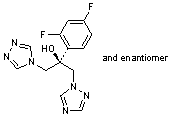
A. (2RS)-2-(2,4-difluorophenyl)-1-(1H-1,2,4-triazol-1-yl)-3-(4H-1,2,4-triazol-4-yl)propan-2-ol,
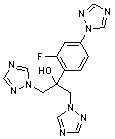
B. 2-[2-fluoro-4-(1H-1,2,4-triazol-1-yl)phenyl]-1,3-bis(1H-1,2,4-triazol-1-yl)propan-2-ol,
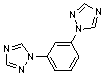
C. 1,1'-(1,3-phenylene)di-1H-1,2,4-triazole,
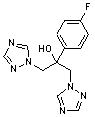
D. 2-(4-fluorophenyl)-1,3-bis(1H-1,2,4-triazol-1-yl)propan-2-ol,
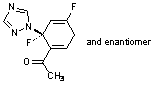
E. 1-[(6RS)-4,6-difluoro-6-(1H-1,2,4-triazol-1-yl)cyclohexa-1,4-dien-1-yl]ethanone,
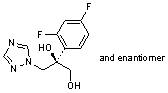
F. (2RS)-2-(2,4-difluorophenyl)-3-(1H-1,2,4-triazol-1-yl)propane-1,2-diol,
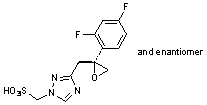
G. (3-{[(2RS)-2-(2,4-difluorophenyl)oxiran-2-yl]methyl}-1H-1,2,4-triazol-1-yl)methanesulfonic acid,
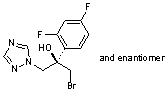
H. (2RS)-1-bromo-2-(2,4-difluorophenyl)-3-(1H-1,2,4-triazol-1-yl)propan-2-ol,
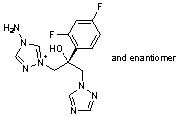
I. 4-amino-1-[(2RS)-2-(2,4-difluorophenyl)-2-hydroxy-3-(1H-1,2,4-triazol-1-yl)propyl]-4H-1,2,4-triazolium.
 |  |