Monographs: Pharmaceutical substances: Ergotamine tartrate (Ergotamini tartras)
Molecular formula. (C33H35N5O5)2,C4H6O6 or C70H76N10O16
Relative molecular mass. 1313
Graphic formula.
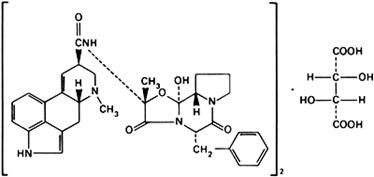
Chemical name. Ergotamine L-(+)-tartrate (2:1) (salt); 12'-hydroxy-2'-methyl-5'α-(phenylmethyl)ergotaman-3',6',18-trione[R-(R*,R*)]-2,3-dihydroxybutanedioate (2:1) (salt); CAS Reg. No. 379-79-3.
Description. Colourless crystals or a greyish white to yellowish white, crystalline powder; odourless.
Solubility. Slightly soluble in water and ethanol (~750 g/l) TS; practically insoluble in ether R, benzene R, and light petroleum R.
Category. Sympatholytic.
Storage. Ergotamine tartrate should be kept in a hermetically closed container, preferably in an inert atmosphere, such as nitrogen, protected from light and stored at a temperature between 2° and 8°C.
Additional information. Even in the absence of light, Ergotamine tartrate is gradually degraded on exposure to a humid atmosphere, the decomposition being faster at higher temperatures.
Requirements
Definition. Ergotamine tartrate contains not less than 98.0% and not more than 101.0% of (C33H35N5O5)2,C4H6O6, calculated with reference to the dried substance.
Identity tests
A. See the test described below under "Related alkaloids". The principal spot obtained with solution B corresponds in position, appearance, and intensity with that obtained with solution C.
B. Dissolve 1 mg in a mixture of 5 mL of glacial acetic acid R and 5 mL of ethyl acetate R. To 1 mL of this solution add 1 mL of sulfuric acid (~1760 g/l) TS, with continuous shaking and cooling; a blue colour with a red tinge develops. Add 0.1 mL of ferric chloride (25 g/l) TS, previously diluted with an equal volume of water; the red tinge becomes less apparent and the blue colour more pronounced.
Specific optical rotation of ergotamine base
• Prepare and use the solution rapidly, in subdued light.
Place about 0.35 g, accurately weighed, in a separator, dissolve it in 25 mL of tartaric acid (10 g/l) TS, add 0.5 g of sodium hydrogen carbonate R, and mix gently. Add 10 mL of ethanol-free chloroform R, shake vigorously, allow to separate, and filter the chloroform-layer through a small filter-paper previously moistened with ethanol-free chloroform R into a 50-mL volumetric flask. Repeat the extraction of the aqueous layer with three 10-mL portions of ethanol-free chloroform R, passing the extracts through the same filter. Place the flask in a water-bath at 20°C for 10 minutes and adjust to 50 mL with the same solvent. Mix the solution and determine the optical rotation at 20°C, preferably using tubes that can be controlled thermostatically. Separately, measure 25.0 mL of the solution, evaporate on a water-bath, and dry to constant weight at 95°C under reduced pressure (not exceeding 0.6 kPa or about 5 mm of mercury). Calculate the specific optical rotation of the ergotamine base from the weight of the residue and the observed rotation;  = -150° to -160°.
Clarity and colour of solution. Add 25 mg of tartaric acid R to 50 mg of the test substance and dissolve at 20°C in 10 mL of water; the solution is clear and not more intensely coloured than standard colour solution Yw2 when compared as described under 1.11.1 Colour of liquids.
Loss on drying. Weigh the substance as rapidly as possible and dry to constant weight at 95 °C under reduced pressure (not exceeding 0.6 kPa or about 5 mm of mercury); it loses not more than 50 mg/g.
Related alkaloids. Carry out the test as described under 1.14.1 Chromatography, Thin-layer chromatography, using silica gel R1 as the coating substance and a mixture of 9 volumes of chloroform R and 1 volume of methanol R as the mobile phase. Place a sufficient volume of mobile phase to develop the chromatograms and a beaker containing 25 mL of ammonia (~260 g/l) TS into the chromatographic chamber, and equilibrate for 30 minutes. Apply separately to the plate 5 μl of each of 3 solutions in the mobile phase containing (A) 5.0 mg of the test substance per mL, (B) 0.25 mg of the test substance per mL, and (C) 0.25 mg of ergotamine tartrate RS per mL. After removing the plate from the chromatographic chamber, allow it to dry in air until the solvents have evaporated, spray it with 4-dimethylaminobenzaldehyde TS2, and examine the chromatogram in daylight. Any spot obtained with solution A, other than the principal spot, is not more intense than that obtained with solution B.
Assay. Dissolve about 0.3 g, accurately weighed, in 15 mL of a mixture of 6 volumes of acetic anhydride R and 100 volumes of glacial acetic acid R1. Titrate with perchloric acid (0.05 mol/l) VS as described under 2.6 Non-aqueous titration, Method A. Each mL of perchloric acid (0.05 mol/l) VS is equivalent to 32.83 mg of (C33H35N5O5)2,C4H6O6.
 |  |